Why Hearing the Child Without Harm Requires Safeguarding, Child Development Literacy and Real Containment
A note on child inclusive practice
This article is written from a firmly child inclusive position. Children’s voices matter. They deserve to be heard, understood and taken seriously in decisions that shape their lives.
In the UK and some other jurisdictions, Child Inclusive Mediation has developed as a safeguarded practice in which a specifically trained mediator may meet with a child, with the informed consent of both parents and the child’s choice to participate. The purpose is not to ask children to decide outcomes but to provide them with a safe, confidential space to share their own thoughts, feelings, worries and wishes and to understand their lived experience so that adult decision making can better protect their wellbeing.
This approach reflects the principle set out in Article 12 of the United Nations Convention on the Rights of the Child, which recognises a child’s right to express their views and for those views to be given due weight in accordance with their age and maturity.
In the United States, child inclusive practice is far less common and there is understandable caution about involving children directly in family dispute resolution. Many of the risks that concern US professionals, including insufficient training, role confusion, misinterpretation of children’s words or undue emotional burden being placed on children, are real. They are precisely why this work must be introduced carefully, ethically and in stages.
Hearing a child well requires developmental literacy, trauma and neurodivergence awareness alongside an understanding of how alignment, resist or refuse dynamics and nervous system regulation shape how children communicate safety and distress. Without this, a child’s voice risks being treated as preference, evidence or instruction rather than meaning.
This is especially critical in court connected or recommendation-based systems, where a child’s words can quickly acquire legal or relational weight.
Voice, not choice
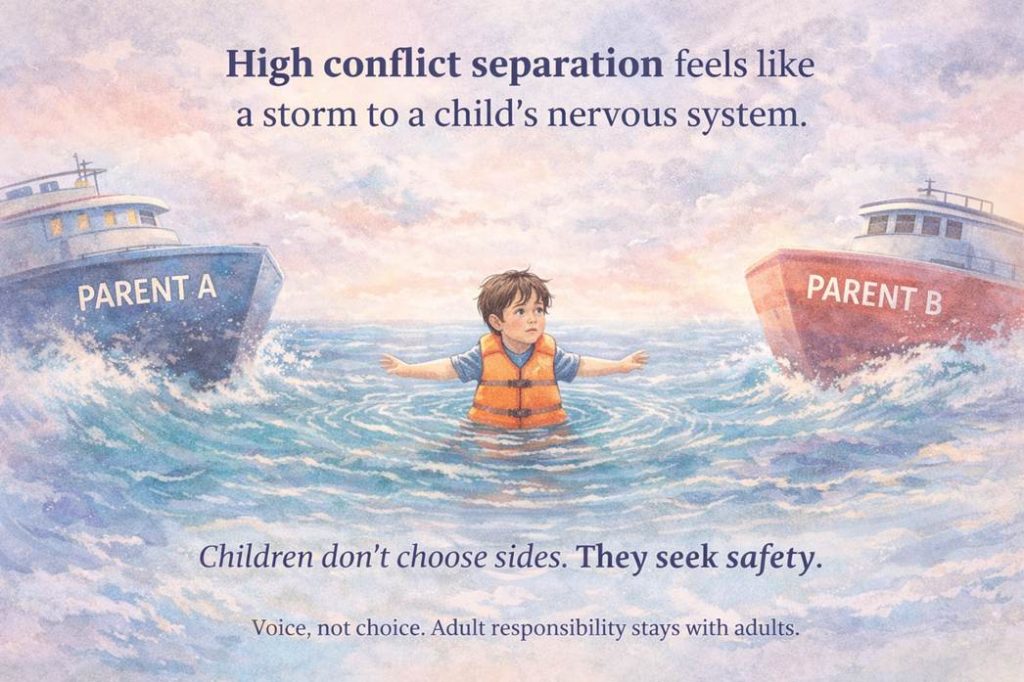
When parents separate, adults often talk about what a child “wants” but to a child’s nervous system, conflict does not feel like a preference question. It feels like being at sea in dangerous waters.
In that storm, children do not choose sides. They seek safety. Some will cling tightly to one parent to stay regulated, some will try to hold a bit of both and become stretched into a loyalty bind and some will disengage altogether because both relationships feel too emotionally costly.
This is why Child Inclusive Mediation is not about asking children what they want. It is about hearing their voice, not burdening them with choice.
As a society, we invest years preparing people for careers, finances, and productivity. Yet early childhood is one of the strongest predictors of lifelong mental health, physical health, relational capacity and resilience, yet parenting is still treated as something people should “just know.”
This is not about blaming parents. It is about recognising that raising humans is one of the most consequential roles in society and one of the least supported. When prevention is absent early, children are later asked to carry decisions, distress, and responsibility that should never have belonged to them.
The risk inside good intention
Child Inclusive Mediation is often described as a progressive and child centred development in family dispute resolution. In principle, it absolutely is. Children deserve to be heard in decisions that shape their lives.
That right is recognised in Article 12 of the United Nations Convention on the Rights of the Child and is increasingly reflected in court linked reforms in several jurisdictions, including the UK’s Pathfinder model, which aims to improve how children’s needs and safety are understood in separation.
I am a strong advocate for Child Inclusive Mediation. I have spent more than two decades working with families and supporting child development. But the greatest risk in this work is not malice. It is misplaced good intention.
When child inclusion is introduced without sufficient safeguarding structure, developmental literacy and clarity about role and responsibility, children can be unintentionally positioned as:
• evidence
• informants
• decision makers
• or the emotional bridge between adults who cannot tolerate uncertainty
A child may speak honestly and still not be safe to act upon without context. A child may also speak strategically, not because they are manipulative but because they are adaptive.
Children adapt to survive.
Child development literacy is not optional
What we need is not simply more mediators or lawyers trained to “speak to children”. We need professionals who understand child development, attachment, trauma and nervous system regulation because there is no single Child Inclusive Mediation process that fits every child.
This is especially true where a child has experienced adversity, relational rupture or where neurodivergence shapes how they communicate distress. Without child development literacy, we risk mistaking behaviour for meaning and preference for protection.
Voice is not the same as responsibility
One of the most misunderstood aspects of Child Inclusive Mediation is the assumption that it involves asking children what they want or worse, giving children a vote.
Ethical Child Inclusive Mediation is the opposite.
It is a contained, developmentally grounded invitation for a child to speak, without being burdened by adult responsibility. A child inclusive conversation should give children a safe space to express:
• how they feel
• what is working well
• what feels hard
• what they wish could be different
Sometimes I will ask children what they would wish for if they had a magic wand. That question often reveals far more than a direct question about arrangements ever could because children do not speak in neat adult categories, they speak through emotion, protection and adaptation. The role of the practitioner is not to extract preference, but to understand meaning beneath the words.
The danger of transmitting a child’s voice raw
A one off, functional child meeting is not enough. This work requires time, containment and care. It requires practitioners who can:
• build rapport without over relying on props, games or distraction
• notice what is not being said as much as what is
• gently return to key themes to check meaning
• support children to express what matters safely
• clarify what can and cannot be shared with parents
It also requires clear planning around what happens next. If children speak to a professional and then never hear anything back, it can feel like another relational loss in an already destabilising time. A child may experience it as “someone listened, then disappeared”.
Ethical Child Inclusive Mediation must therefore include clarity about feedback and follow through, including how parents will respond to what the child has shared and how that response will be contained and communicated. Children need adults who stay steady.
When children are asked to choose, they carry the consequences
When children are placed in the position of choosing, even subtly, they carry emotional consequences. They may feel responsible for a parent’s distress, fear retaliation or learn to say what stabilises the system rather than what is true.
Once a child realises their words can move adult outcomes, the child’s voice becomes loaded. Not liberated. This is why the phrase Voice, not choice is critical.
This is not semantics. It is safeguarding. It protects children from becoming evidence in adult conflict and it protects mediation from becoming another adversarial channel.
Resist or refuse dynamics are often safety responses
Few issues trigger adult fear like a child refusing contact and in separated families, refusal is often interpreted as:
• a child making a decision
• a child being influenced
• a child being difficult
• or a child rejecting a parent
But in many cases, resist or refuse dynamics are better understood as nervous system regulation. A child may avoid a parent not because they do not love them, but because contact feels emotionally costly. They may be trying to:
• reduce distress
• preserve attachment
• avoid divided loyalty
• reduce emotional load
• avoid interrogation or adult narratives
• stop feeling like the reason one parent collapses
Many children need an anchor, a stable emotional reference point that helps them feel safe. When that anchor is missing or unstable, children can become a prize or a weapon inside adult conflict rather than a person with needs of their own. This is not preference, it’s protection.
Alignment versus alienation, the distinction that changes outcomes
We are living in an era where the term ‘alienation’ is used more and more, often quickly and often emotionally. Sometimes there are genuinely alienating dynamics and they must be taken seriously but I also see many cases where what is being labelled as alienation is better understood as alignment.
Alignment is often a coping strategy and children align for many reasons: to reduce fear, to maintain security, to stabilise a parent, to avoid conflict or because divided loyalty is unbearable. When we misread alignment as manipulation, we intervene in ways that increase pressure, increase threat and increase withdrawal. Meaning must come before judgement.
Trauma informed care must also be neurodivergence informed care
Trauma and neurodivergence are often discussed separately but in family conflict, they collide and without neurodivergence awareness, trauma responses are often mislabelled as defiance, manipulation or risk. Without trauma awareness, neurodivergent behaviour is treated as something to control rather than something to understand. The result is escalation and harm.
A child who shuts down may not be refusing. They may be overloaded.
A child who becomes rigid may not be difficult. They may be dysregulated.
A child who cannot explain their feelings may not be lying. They may be overwhelmed.
If practitioners do not understand how stress impacts communication, the adult system will interpret the wrong meaning and respond in ways that escalate rather than contain.
Child first does not mean child led
A child first approach is not the same as a child led outcome.
Children should not be asked to choose between parents. They should not be asked to design schedules. They should not be placed in the role of emotional referee. Our responsibility is to keep adult responsibility with adults.
Child Inclusive Mediation works best when it strengthens the parental alliance around the child’s wellbeing rather than placing the child at the centre of adult conflict. In high conflict cases, the child’s voice must be handled with exceptional care. A child’s words cannot be used as a shortcut to adult clarity.
A question for practitioners
If you practise Child Inclusive Mediation, I want to invite some careful reflection. Not because you are not caring or uncommitted but because the stakes are high.
Ask yourself:
• Do I understand the child’s brain under stress
• Do I understand resist or refuse as nervous system regulation
• Can I recognise loyalty binds and survival alignment
• Can I hold the child’s voice without turning it into responsibility
• Do I understand trauma responses and neurodivergent communication
• Can I feedback meaning without escalating adult conflict
Because Child Inclusive Mediation is not a title. It is a safeguarding responsibility.
Why this conversation is urgent
In recent conversations with professionals across jurisdictions, one theme has been strikingly consistent. Child Inclusive Mediation remains rare, is often misunderstood and is sometimes treated as risky or non-standard practice.
I don’t believe this is because it is not needed, but because it can be misapplied, and professionals are right to be cautious. When a child’s voice is treated as preference, it becomes dangerous. When it is treated as evidence, it becomes dangerous. And when it is transmitted raw into adult conflict, it becomes dangerous.
The gap is not whether a child’s voice matters but whether we are trained to hold it safely. In my own practice, and in the training and reflective work we deliver, the focus is not on whether children should be included, but how. Ethical child inclusive practice requires developmental literacy, trauma and neurodivergence awareness, and strong professional containment so that adult responsibility remains firmly with adults.
This is not about creating a new technique but about equipping practitioners to hear children safely and to hold meaning without transmitting burden.
Hearing the child without harming the child
Children do not need more adults repeating their words. They need adults who can truly hear what those words are carrying.
Child Inclusive Mediation, done well, can reduce pressure on children and restore adult responsibility where it belongs but done poorly, it can unintentionally place the child at the centre of adult conflict and call it empowerment. The child’s voice matters but it must be held, interpreted and contained not transmitted.

Barbara McAdoo shares her disappointment with how the field has not been defined and how mediators cannot communicate what mediation is to consumers.
By Barbara McAdooAll of the presentations delivered at the Vancouver conference (as well as several papers submitted by attendees) are available in-line in the Online Agenda at www.odrandconsumers2010.org/agenda. I. Introduction eCommerce has grown rapidly, riding the expansion of information and communications technology around the world, and transforming the way goods are bought and sold. Businesses...
By Colin Rule, Doug LeighMorrow Mediation Blog by Bernard MorrowThe use of the joint session in mediation has been a hot topic of study and debate in recent years. I have weighed in on the...
By Bernard Morrow