Abstract
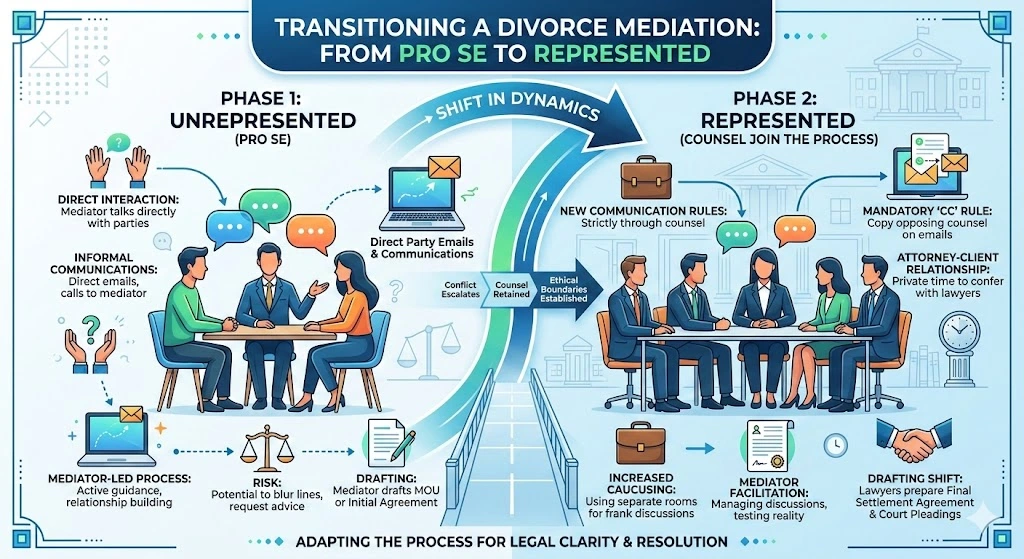
Have you ever felt the “whiplash” of a mediation case suddenly shifting from pro se to represented mid-stream? It’s a common scenario in divorce mediation. You spend hours building rapport, understanding the nuances of the parties’ lives, and guiding them through a vulnerable process. Then, the dispute escalates, counsel is retained, and the entire architecture of the room changes.
It is easy to still feel a bond with them as your “clients.” But ethically and procedurally, the introduction of lawyers means our role as neutral facilitators must immediately adapt.
I just put together a comprehensive guide on navigating this exact transition. In my latest article, I break down the practical and ethical steps mediators must take to protect the process, respect the new attorney-client relationships, and maintain absolute neutrality.
Key takeaways include:
Reframing the Relationship: Why we must mentally shift from viewing them as “clients” to “parties.”
The “CC” Rule: How to firmly and politely handle those inevitable direct emails and texts once attorneys are involved.
Updating the Paperwork: Why your original Agreement to Mediate (ATM) is no longer sufficient, and what to include in an Addendum.
Drafting Limits: Avoiding the Unauthorized Practice of Law (UPL) when it comes to the final Settlement Agreement.
The Dilemma
It is a common scenario in family and divorce mediation: two unrepresented parties begin the process with the best of intentions, but as the dispute escalates, the emotional and financial stakes push them to retain legal counsel
For the mediator, this mid-stream transition can feel jarring. You have built a direct, intimate rapport with these individuals. Yet, when counsel steps in, the architecture of the mediation must fundamentally change. Adapting to this new dynamic requires a shift in mindset, strict adherence to communication protocols, and a restructuring of the mediation process to respect and utilize the presence of counsel.
Here is how mediators can successfully navigate the shift from unrepresented to represented parties.
1. Reframing the Relationship: They Are Parties, Not Clients
When mediating pro se individuals, the mediator often plays a highly active role in guiding the process, which can make the parties feel like “clients.” However, ethically, a mediator has no clients. You are a neutral facilitator.
Once attorneys are retained, it is vital to mentally and verbally reinforce this boundary. The attorneys now hold the fiduciary, attorney-client relationship. Continuing to view the participants as your “clients” can inadvertently lead to overstepping boundaries, offering what might be construed as legal advice, or undermining the attorneys’ strategies. Your primary duty remains to the process of reaching a voluntary resolution, not to advising the individuals.
2. Establishing New Communication Protocols
The most immediate and critical change involves how you communicate. Once a party is represented by counsel, standard legal ethics dictate that you must not bypass the attorney to communicate directly with the party regarding the substance of the dispute.
3. Pre-Mediation Meetings with Counsel
Before bringing everyone back to the table, it is highly advisable to hold a pre-mediation telephone conference with the newly retained attorneys—either together or in separate caucuses.
Goals of the Attorney Pre-Meeting:
4. Administering the Mediation Session
When the mediation reconvenes, the physical and psychological space will feel different. You are no longer the sole legal professional in the room.
Conclusion
Transitioning a mediation from pro se to represented is not a failure of the initial process; it is simply a new phase of the dispute. By strictly enforcing communication boundaries, actively engaging with the new counsel, and stepping back into a purely neutral, facilitative role, you can leverage the attorneys’ presence to help the parties achieve a durable, well-advised resolution.
Specific clauses and modifications you should incorporate into your updated ATM or Addendum:
1. Acknowledgment of Representation
You must formally document that the parties are no longer representing themselves and that the mediator’s role is strictly neutral.
2. Strict Communication Protocols (The Direct Email Fix)
This is the most critical modification based on your concerns. You need a contractual boundary preventing the parties from treating you as their direct sounding board.
3. Role of Counsel in Mediation
Clarify how the mediation sessions will be conducted now that attorneys are involved.
4. Drafting of the Settlement Agreement
When parties are pro se, mediators often draft a Memorandum of Understanding (MOU) or even the Marital Settlement Agreement (MSA) depending on the jurisdiction. Once counsel is retained, drafting responsibilities usually shift to the attorneys.
5. Caucusing and Confidentiality
Attorneys often use caucuses (private breakout rooms) to have frank, privileged discussions with their clients. Your agreement should reiterate how confidentiality works in this new dynamic.
Implementation Tip: Do not just email this to the parties. Send the Addendum directly to the new attorneys. Introduce yourself, welcome them to the process, and ask them to review the Addendum with their clients, sign it, and return it prior to the next scheduled session. This establishes your authority and respect for their role immediately.
ADDENDUM TO THE AGREEMENT TO MEDIATE: REPRESENTATION BY COUNSEL
This Addendum is made to the original Agreement to Mediate dated [Date of Original ATM], by and between [Name of Party A], [Name of Party B] (collectively, the “Parties”), and [Your Name/Firm Name] (the “Mediator”).
WHEREAS, the Parties initially entered into mediation as unrepresented (pro se) individuals; and
WHEREAS, since the execution of the original Agreement to Mediate, both Parties have retained independent legal counsel to advise and represent them in this matter;
NOW, THEREFORE, the Parties, their respective counsel, and the Mediator agree to modify and supplement the original Agreement to Mediate with the following terms:
1. Acknowledgment of Representation and Mediator’s Neutral Role
The Parties acknowledge that they are now represented by counsel. The Mediator remains an impartial, neutral facilitator who does not represent either party. The Mediator will not provide legal advice, make legal determinations, or predict court outcomes. The Parties acknowledge that they will rely exclusively on their respective attorneys for legal advice, strategy, and the assessment of their legal rights and obligations.
2. Mandatory Communication Protocols
To protect the integrity of the mediation process and respect the attorney-client relationship, all communication protocols are hereby modified:
3. Attendance and Role of Counsel
Counsel for the Parties shall attend and participate in all future mediation sessions unless their absence is expressly waived in writing by all Parties and Counsel. The attorneys’ role is to advise their clients and advocate for their legal interests. The Mediator’s role remains to manage the process, facilitate constructive dialogue, and assist the Parties and their Counsel in exploring settlement options.
4. Caucusing and Confidentiality
The Mediator may conduct private caucuses (breakout sessions) with a Party and their attorney. The Mediator will maintain the strict confidentiality of these caucuses and will not disclose any information, offers, or discussions shared during a private caucus with the other side unless explicitly authorized to do so by the caucusing Party and their attorney.
5. Drafting of Settlement Documents
Should the Parties reach a consensus, the Mediator may, at the Parties’ request, prepare a non-binding Term Sheet or Memorandum of Understanding (MOU) reflecting the substantive points of the agreement. However, the preparation, formal review, execution, and filing of the final Marital Settlement Agreement (MSA) and any associated court pleadings shall be the sole responsibility of the Parties’ legal counsel.
6. Continuation of Original Terms
Except as expressly modified by this Addendum, all terms, conditions, and confidentiality provisions of the original Agreement to Mediate remain in full force and effect.
By signing below, the Parties, their Counsel, and the Mediator acknowledge their understanding and agreement to these modified terms.
[Name of Party A]
Signature: ___________________________ Date: ______________
[Name of Attorney for Party A], Counsel for Party A
Signature: ___________________________ Date: ______________
[Name of Party B]
Signature: ___________________________ Date: ______________
[Name of Attorney for Party B], Counsel for Party B
Signature: ___________________________ Date: ______________
[Your Name], Mediator
Signature: ___________________________ Date: ______________
Here is a draft for the introductory email. This email is designed to welcome the attorneys, demonstrate respect for their role, and firmly establish the new procedural boundaries so everyone is on the same page.
Subject: Mediation in [Last Name] v. [Last Name] – Introduction and Procedural Updates
Dear [Name of Attorney A] and [Name of Attorney B],
I am writing to introduce myself as the mediator in the [Last Name] matter. I look forward to working with both of you to help your clients reach a resolution.
As you likely know, [Party A] and [Party B] initially began this mediation process with me unrepresented. I am glad they have now retained counsel to advise them as we move forward. Because the architecture of the mediation fundamentally changes with your involvement, I need to update our procedural framework to respect your roles and protect your attorney-client relationships.
To that end, please find attached an Addendum to the Agreement to Mediate. This addendum formalizes three key shifts:
Please review this Addendum with your respective clients, sign it, and return it to me prior to our next scheduled session.
Next Steps: Pre-Mediation Call Before we reconvene with the clients, I find it highly productive to have a brief pre-mediation telephone conference with counsel. This will allow me to get up to speed on your legal postures, discuss logistics, and understand how the landscape of the negotiation has shifted from your perspectives.
Are you both available for a 15-minute joint call on [Date/Time option 1] or [Date/Time option 2]? Alternatively, I am happy to speak with you each separately if you prefer.
Thank you, and I look forward to collaborating with you both.
Warm regards,
[Your Name] [Your Title/Firm] [Your Contact Information]
The Audited Guide: Mediation Protocols and Ethical Directives
1. Protocol: Re-establishing Neutrality (Parties, not Clients)
When parties transition from pro se to represented, the mediator must verbally and contractually reaffirm that they have no clients and offer no advice.
2. Protocol: Implementing Strict Communication Rules (The “CC” Rule)
You must establish a firm boundary preventing direct, substantive emails or calls from the parties that exclude their new attorneys.
3. Protocol: Shifting Drafting Responsibilities (Avoiding UPL)
While a mediator may write down a basic Term Sheet or Memorandum of Understanding (MOU), the drafting of the final, legally binding Marital Settlement Agreement (MSA) must shift to the newly retained attorneys.
4. Protocol: Utilizing Pre-Mediation Counsel Meetings and Caucusing
The mediator must engage with the new attorneys to understand their legal posture, often relying more heavily on private caucuses (breakout rooms) to allow for privileged attorney-client discussions.
CHEAT SHEET: Handling Direct Emails from Represented Parties
Scenario 1: The “Gentle Reminder” (First Offense / Administrative)
Use this when the party emails you something relatively benign or simply forgets to CC their attorney.
Subject: Re: [Original Subject Line] – CCing Counsel
Dear [Party Name],
Thank you for your email. Because you and [Other Party’s Name] are now represented by counsel, my ethical guidelines require that all communications regarding our mediation include your attorneys.
I know it is an adjustment after working together directly for a while! I have copied [Attorney’s Name] and [Opposing Attorney’s Name] on this reply so everyone stays in the loop. Moving forward, please just be sure to CC them on any emails to me.
Best regards,
[Your Name]
Scenario 2: The “Firm Boundary” (Discussing Substance or Venting)
Use this when the party emails you directly to argue their case, vent about the other side, or propose a settlement idea without their lawyer.
Subject: Re: [Original Subject Line] – Mediation Protocol
Dear [Party Name],
Thank you for reaching out. As a neutral mediator, I cannot engage in direct, one-on-one discussions about the substance of your case now that you are represented by counsel. My role is to facilitate the process, while your attorney’s role is to advise and advocate for you on these specific issues.
Please share these thoughts directly with [Attorney’s Name]. If you and your attorney decide this is something we should discuss in our next mediation session, we can certainly put it on the agenda. I have copied your attorney on this email so they are aware of your outreach.
Best regards,
[Your Name]
Scenario 3: The “Emotional/Urgent Escalation”
Use this when the party is highly distressed, angry, or claiming an emergency, seeking your intervention.
Subject: Re: [Original Subject Line] – Next Steps with Counsel
Dear [Party Name],
I hear that you are incredibly frustrated and that this is a very stressful moment. Because you have retained legal representation, I must step back from advising or intervening directly.
Please contact [Attorney’s Name] immediately to discuss this situation. They are in the best position to advise you on your legal options and how to handle this development. I have CC’d your attorney here so they know you are needing immediate guidance.
Best regards,
[Your Name]
Scenario 4: Forwarding to the Attorney (The “Behind the Scenes” Note)
Sometimes, it is best not to reply to the client at all, but rather forward their email directly to their attorney so the attorney can manage their client.
Subject: FW: [Original Subject Line] – Direct outreach from [Client Name]
Hi [Attorney’s Name],
I am forwarding the below email I just received directly from your client. In keeping with my neutral role and our communication protocols, I have not responded to them.
I will leave it in your hands to connect with [Client Name] regarding these concerns.
Best,
[Your Name]

Collaborative law, a process in which lawyers and their clients contractually agree to pursue non-adversarial means of resolving disputes and reaching agreement without going to court, has become an increasingly...
By Diane J. LevinREPRINTED WITH PERMISSION. Reprinted from Dispute Resolution Journal, February 1998. Published by the American Arbitration Association, 335 Madison Avenue, New York, NY 10017 © 1998The intent of Title I, the...
By Judith Cohen, Samuel H DeShazerPeter Adler talks about advice he might give to novice mediators: have perseverence, be realistic in the work mediators do, don't have high expectations of soap-opera style mediation.
By Peter Adler