Alessandra Sgubini, a professional mediator, argues that using positive language leads to healthier relationships and a more peaceful society. Drawing on her experience resolving business disputes and conducting workshops, she emphasizes the powerful impact words have on both the speaker and the listener. She highlights the importance of learning to rephrase negative language and use positive communication to prevent conflicts, create a better environment, and ultimately contribute to a healthier life.
Listen to the NotebookLM AI Podcast of this article:
A few years ago, I started a series of children’s books after spending more than two decades of my professional life promoting, teaching, and applying alternative conflict resolution methods such as mediation to resolve business disputes in the USA and Italy. The purpose was to teach and promote through illustrated storytelling and unique book formats the concepts of conflict resolution and problem solving to the new generations of adults, as one day they will lead the world.
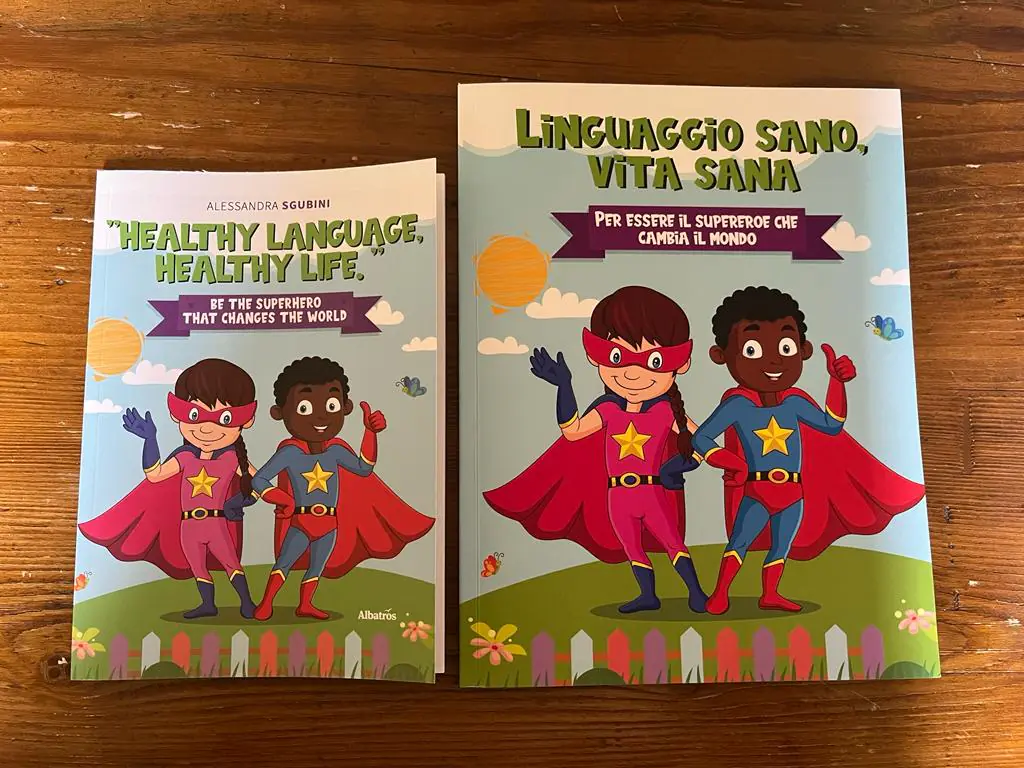
In the era of social media and AI, the following article brings the attention to something highly important—the power of words. By understanding the power of words, each individual can make or break the outcome of the conversation and eventually of the interaction. The article summarizes the findings of live tests and workshops conducted to prove the actual power of words. The results were so revealing, they led me to write the latest children’s book of the series on the importance of healthy language for mental and physical health. Healthy language, healthy life: Be the superhero that changes the world available on Amazon.com in the US and has been translated in Italian on Amazon.it and published by Italian editor Albatross Il Filo.
It All Started from Observing Real Life Events
Everything started one day while I was watching television. There was a puzzling verbal aggression spoken by influential individuals, who were using negative, aggressive, and offensive words to address the other person or describe a situation. My confusion came from thinking those on TV or in a position of influence should be more careful regarding what they say and how they say it. I was shocked at how they were using the most negative and aggressive language (verbal and non-verbal). My amazement increased when the next news came on, in which people were shocked at the violence, hatred, and aggression in the young generation and in ordinary life situations, such being stuck in traffic.
I took a breath, and I wondered why everyone was surprised.
Everything we tolerate, we authorize, so why are we not surprised when we tolerate aggressive language from those who should be the examples of conduct and morals and we are then shocked at violence and aggression as the result of those examples.
The negative language affected me negatively. I felt dirty, I felt angry and disturbed, so I turned the TV off.
I thought, what if this negative language was spoken in a workplace, in a family, in school and among friends? How was the young generation affected by being exposed daily to negative words through social media, TV, and peers?
Unfortunately, in these cases, we cannot turn off life situations like the TV.
I started to pay attention and observe how people (general and public figures) actually communicate, which words they choose to express their thoughts, ideas, opinions and feelings.
I noticed some parents using negative words toward their own children, husband, or wife. They referred to each other in an aggressive way. And politicians were saying things on national TV or social media that were difficult to believe they would speak or act like that toward their loved ones.
I could go on and on with examples, from the workplace to the encounters at the grocery stores.
These things I witnessed bothered me so much that I decided to do a series of tests followed by workshops that lasted almost a year. I wanted to see how the use of positive or negative language (verbal and non-verbal) influenced the reaction of my interlocutor and also how the person who spoke was affected by.
My head was spinning, and not in a good way. I was noticing that based on how people speak (verbal and non-verbal language), they tended to get in trouble somehow, and they were the reasons for their own conflicts and the conflicts with others. The bad mood and negative feelings generated by those words brought them into a black hole, along with those next to them.
I thought, one of the first great milestones of childhood is the conquest of language. Starting from the first words, the child begins to acquire the ability to communicate his needs in a clear and direct way. The role of parents and educators in this delicate stage of growth is to provide the most appropriate tools for effective communication, encouraging the propensity for dialogue and highlighting the meaning and weight of words. This is not always a simple challenge: in school, songs, TV, social media and community contexts where the phenomenon of bullying continues to proliferate, it can happen that children learn aggressive, sometimes even violent, language. Learning to communicate effectively—and therefore acquiring correct and functional behavior—becomes a real challenge.
It’s so vital to educate children on how important the language chosen to communicate with others is, in any environment.
From Observation to Live Tests
Observation showed how the average person used negative and aggressive words toward their own family members, friends, and co-workers without even thinking or being aware of the consequences.
The tests had the following objectives: (1) see how the use of positive or negative language (verbal and non-verbal) influenced the reaction of the interlocutor and the speaker. Moreover, (2) if the choices of word could prevent conflict. Finally, (3) I wanted to understand if people were aware of the power of words and how their choices affect them.
I am not a scientist, so first I tested on myself and on my family and friends.
I decided to use only positive language (verbal and non-verbal) to communicate anything in any situation. Pay close attention to how the other person responded and how I was feeling. Second, I decided to use negative language (verbal and non-verbal) to communicate.
The results were truly clear and obvious. Based on my choices, I was able to open a dialogue and prevent difficult situations, or create barriers and generate conflicts. Moreover, what got my attention was how my wellbeing (my mental and physical health) was affected by the words.
In the next step, I asked my close circle of people to think before expressing their ideas, thoughts, and concerns and to choose positive words to communicate in all situations.
I start to ask questions, such as, “How do you feel when someone uses an abusive language or aggressive tone?”
All of them came back to me after a week and confirmed my findings: They didn’t know how to act and what to do when people addressed them with a negative language. The majority of people avoided the person who used negative language because they felt they were not willing to communicate and negative emotions rose. Moreover, they incubated resentment and anger while doubting themselves. Almost everyone shared that they needed to think to choose positive words. Moreover, all had unpleasant feelings and started to doubt themselves, and their wellbeing felt less stable when they encountered negative words.
We all have the skills to prevent difficult situations using healthy language.
Healthy language led to healthy behavior, and in this modern age, where conflict and aggression are everywhere, between everyone, and it seems the madness is increasing daily, if you know how to communicate, it can be seen as a superpower.
To overcome the challenge of negative and aggressive words, I shared with them some tools to neutralize the negative words, such as rephrasing and neutralizing negative language (verbal and non-verbal) into positive communication. It wasn’t easy at first, but with a little practice, they were able, from the youngest to the oldest, to neutralize the negative words and turn the conversation in a positive direction.
Finally, as part of the last part of the tests, I let them be the observers and watch the world around them and report how many times they heard negative or positive language.
The test’s results were eye opening.
People directly involved in the tests were in shock at how difficult is to communicate and open a dialogue choosing positive language. They realized they didn’t know how to rephrase and neutralize negative words. What shocked all was that through their language choices, they could prevent or generate conflicts, and they were responsible for the reaction of others. Moreover, they realized that when in conflict or when choosing the wrong words, their health was affected by stress, negative thoughts, and undermined self-confidence.
The Next Level was Real Life Workshops and Classes
A few months later, I organized workshops with children from eight to sixteen years old, their parents (average age forty to fifty years old), and the university’s business classes students (average twenty-three to twenty-eight years old). The main goal was to expose them to the power of words, teach techniques to improve and to turn a conversation from negative to positive to open an effective dialogue, and to prevent conflicts and consequently have a healthy life.
The workshops have led to surprising results, especially when testing the children together with their parents and the university students. Three completely different audiences.
Children and teens were open, curious, and all of them had a big smile; the other part of the audience, the parents, had expressions showing skepticism, disbelief, they were thinking they already know all of this, thinking they were attending only for the children.
Half an hour in the workshop, thanks to the games, activities, songs, illustrated storytelling, and videos the parents started realizing that using healthy langue is not as easy as it seems.
The magic box game taught the power of language. To be able to effectively communicate thoughts, desires, fears, and knowledge, each individual needs to learn the elements of language, such as verbal words, body language, tone of voice, emotions, and mindset. The communication process is a two-ways process, one is the speaker and the other the listener. Both have a fundamental role in the process that determines the success or failure of the message. All those elements need to be in perfect balance to be able to prevent conflicts. Choosing positive and correct words combined with the right time to talk, the right emotional state of mind, and a positive tone of voice enables us to deliver and receive the correct message. It’s important to observe what is going on in each of us and in others. Recognizing your own emotions and those you talk to is essential to being effective, because those affect the verbal words, the body language, and the tone of voice.
An example is the use of irony and sarcasm.
Individuals of all ages think what is funny for them is not funny for everyone. We need to take into consideration that others simply don’t understand the joke or it’s not the current mood to joke around. So, when, during the workshop, a child told what happened to him during physical education class, everyone understood and could relate to him.
He and his classmates were doing the squats, and the child laughing said to another classmate, “You look like clumsy bears.” A child who failed and was clumsier was affected in a negative way from the simple joke, and she stopped doing the squats and started to dislike the boy. This can create barriers, involuntary for sure, which prevent the flow of the conversation.
The game taught that jokes and sarcasm required the perfect balance of all the language’s elements. Think of many other scenarios in which the elements of language are not in balance, such as those who shout to communicate, those who say bad words to express what they want or think, those who with an aggressive attitude want to bully others and so on. Look around, just watch TV and you can relate.
Another game that puts everyone of all ages at the same level is the “cloud game.” Each participant was given paper and pencil and asked to design many clouds.
I designed and created a deck of cards, double-sided. Each card had a negative word on one side and the same word in positive on the other side. A card was drawn from the deck, and the participants needed to neutralized and re-phrased negative sentences and words with positive and more effective words. They needed to write on the paper with clouds their choices.
Two color paddles, one green and one red, were used. If the positive word chosen was approved by everyone, the green paddle was raised, otherwise the red one.
One example: A young boy, eleven years old, said to the little sister, six years old, “You are silly – you don’t know how to talk and write in Italian.”
With healthy language in a healthy life, the brother would have said:
Come over here and I’ll teach you how to spell correctly.
The Outcome
It was amazing, because the audience learned the skill to think before talking. The individual is the only one who can choose the words and control how to say things, knowing that it will affect the person listening as well as themselves as they are speaking. Each of us can only control what we say, not what others are saying.
When bad words are spoken, people are affected. Generally, they take it personally and remember how they felt when negative or positive words are said, and they react in a way that conflicts arise, or an easy conversation starts. When conflicts arise, chaos is created, and chaos leads to madness. When individuals are in chaos and madness, everyone losses something. It is better to prevent conflicts rather than resolve them with the power of words.
I learned that children are great at this, perhaps better than the adults, because the grown-ups are anchored to what they know and not very elastic. The activities and games made working on an important topic easier, while having fun, and it brought everyone together. The grown-ups had difficulties in certain games compared to the children, who instead responded without worrying about right or wrong and learned and applied immediately for the next game. The children understood the importance of the language toward others and themselves. The adults, who were accustomed to negative word patterns, found help in the children’s simplicity in finding positive words. The majority understood that before said anything they needed to think and do a check on their emotions that generally determined the choice of words.
At the end, the parents were using the two-color paddles in their families. The idea to introduce into the family group the two-color paddles allowed all of them to watch the words used by the family members. When the language was inappropriate, the paddles and the expression “Healthy language healthy life” were used to prevent fights.
The tests and workshops ran for several months, with different audiences and in two different countries (culturally different). What we learned in these efforts made me decide to write the children’s book Healthy Language, Healthy Life: Be the Superhero that Changes the World.
The challenge was how to summarize everything in a book for children and grown-ups where everyone could have fun while learning. The book has a self-learning style, with a unique and fun format, mainly for children but easily extended to the parents and educators, where a roadmap conducts the readers on a journey. The children find an initial assessment to see where they are in their journey. The illustrated storytelling (available also in video-cartoon with QR) can be read and watched together with children, and all four stories intersect different concepts, such as being confident, communication, and decision making processes. Each of us decides who we want to be. There is a song with lyrics and music notes that summarizes the stories for those kids who play an instrument. There is a “journey diary” to follow the improvement and stay on track. Finally, there are “Practical Worksheets” that teach techniques on how to use healthy language, such as the techniques of neutralizing, re-phrasing, asking questions, and active listening, which are all needed to open a dialogue to communicate your needs or points of view without having to argue or use negative language. Eventually, you will learn to “defend yourself” from the offenses received and aggressive language.
At the end, the children find a self-evaluation tests: in this way, they will be able to recognize whether their communicative approach is already well underway or still needs to be reviewed.
Conclusion
Today, adults have a huge responsibility toward the new generation to let them know that conflict creates chaos and chaos leads to madness. And when we are in chaos and madness, everyone loses something. So, it’s time to act together to change the trend of violence, counterbalancing the aggressive language and attitude used by adults and tolerated more and more these days with healthy language and a positive mindset. The final goal is to form a class of new adults capable of interacting in constructive and collaborative ways with each other. The ambition is that through the children’s new behavior, eventually, adults will learn as well.
This is not something you can learn overnight, it requires time and patience, it must be practiced over time, and it can be applied to any kind of situation. It takes time to unlearn unhealthy communication and behavior.
If we want to see a better world around us, each of us needs to be the better world while making the difference that changes the environment we live in.
Language influences the interactions between people and creates conflict when it is not positive. If we all think before we speak, observe others, listen, and ask questions instead of assuming, we would be able to prevent many conflicts and be happier and healthier. We should all strive for healthy language, healthy life.
Click this link to view Healthy Language, Healthy Life on Amazon.com
Main Theme:
The power of language to influence interactions, prevent conflict, and impact mental and physical well-being.
Key Ideas & Facts:
Negative language breeds negative consequences: Observing public figures and everyday interactions, Sgubini noticed a pervasive use of aggressive and negative language. This observation sparked a concern about its impact on individuals and society, particularly the younger generation.
“Everything we tolerate, we authorize, so why are we not surprised when we tolerate aggressive language from those who should be the examples of conduct and morals and we are then shocked at violence and aggression as the result of those examples.”
Live tests revealed the impact of language choices: Sgubini conducted experiments using positive and negative language in her own interactions. The results showed a clear correlation between language choice and the interlocutor’s reaction, conflict prevention, and personal well-being.
Workshops highlighted the need for conscious communication: Workshops with children, parents, and university students revealed that while people understand the impact of negative language, they often struggle to consciously choose positive words. The “magic box” game emphasized the need to balance verbal words, body language, tone of voice, emotions, and mindset for effective communication.
“The communication process is a two-ways process, one is the speaker and the other the listener. Both have a fundamental role in the process that determines the success or failure of the message.”
Learning to neutralize negative language: The “cloud game” engaged participants in rephrasing negative sentences and words with positive alternatives. This exercise demonstrated the feasibility of shifting communication patterns towards a more positive and constructive approach.
“Healthy Language, Healthy Life” initiative: Based on her findings, Sgubini wrote a children’s book, “Healthy Language, Healthy Life: Be the Superhero that Changes the World,” to equip children and adults with tools for positive communication. The book offers practical worksheets teaching techniques like neutralizing, rephrasing, asking questions, and active listening.
Conclusion:
Sgubini argues that adopting a conscious approach to language, focusing on positivity and constructive communication, can significantly impact individual well-being and prevent conflict. This shift requires conscious effort and practice, but the benefits – improved relationships, mental health, and a more peaceful environment – are substantial.
“If we want to see a better world around us, each of us needs to be the better world while making the difference that changes the environment we live in.”

Respected dispute resolution scholar and pioneer Carrie Menkel-Meadow recently posed an important question for our field in her essay "Why Hasn't the World Gotten to Yes? An Appreciation and Some...
By Diane J. LevinThis article originally published in The Huffington Post on 1/6/14.Leah was still chained to her ex-husband: two years after the civil court granted her a divorce. Her ex-husband Dovid, a...
By Morghan Leia RichardsonPGP Mediation Blog by Phyllis G. Pollack In my April 16, 2010 blog, I discussed the appellate decision of Porter v. Wyner, Case No. B211398 (April 8, 2010) (“Porter”). In...
By Phyllis Pollack