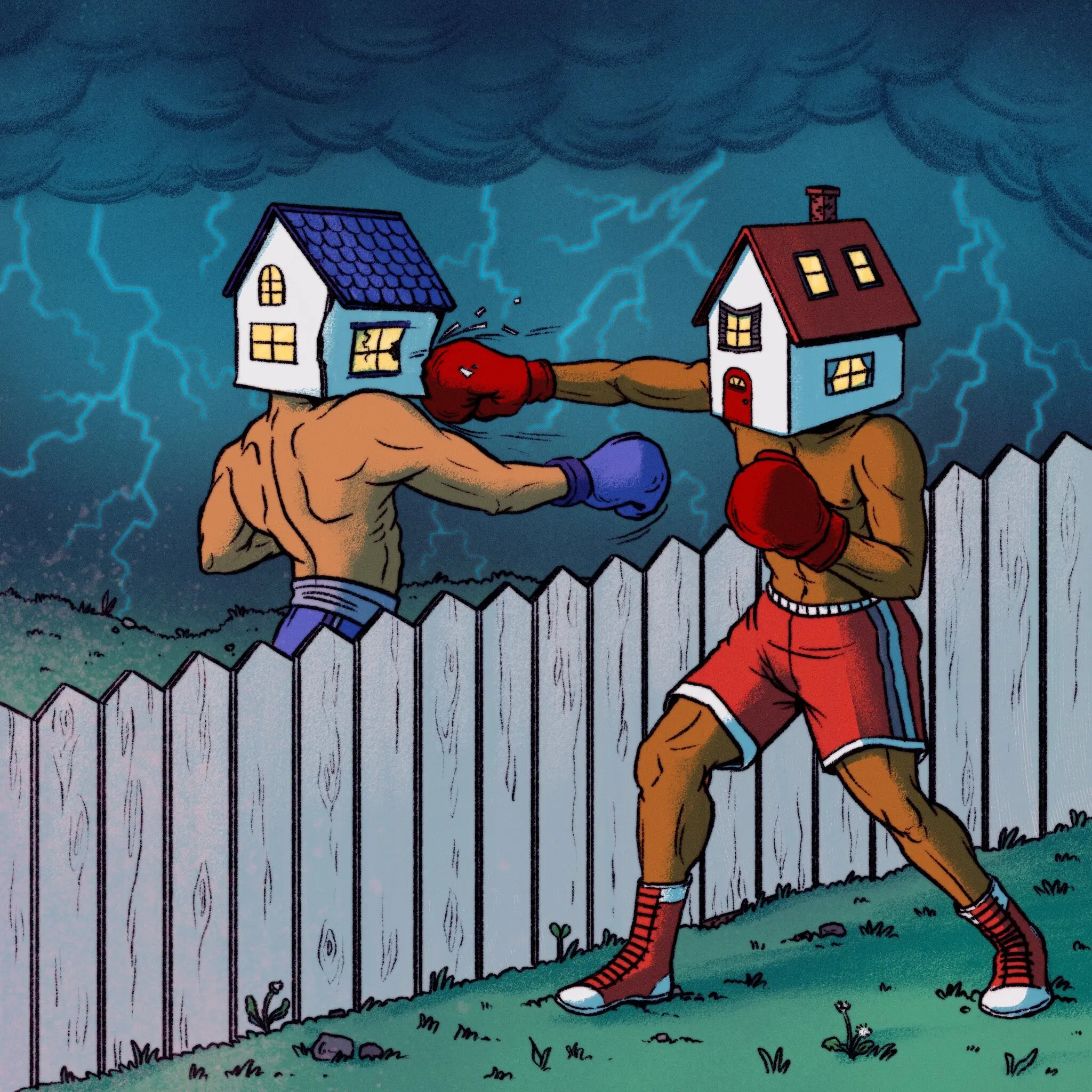
Advice from experts on how to keep disputes from escalating and get to a resolution.
Our homes are our castles, and sometimes the enemy is at the gate — in the form of a disagreeable neighbor. They might not like how we park our cars or empty our trash, or think that our trees are dropping too many leaves on their lawn. However innocuous the first offense, arguments between neighbors can escalate quickly. The recent HBO documentary series “Neighbors” has cataloged neighbors fighting pitched battles, often involving police and the brandishing of firearms over a strip of grass, a feral cat colony and Halloween decorations, to name a few.
These may seem like extreme cases, sensationalized for TV, but a threat to your home can feel dramatic. “Our home is our private space, our sacred space, and when people encroach up upon that, it really impacts us,” said Nick Schmitt, senior director of conflict resolution and training at Community Mediation Services, Inc., in Queens, N.Y.
Here’s what you can do to avoid a “Neighbors”-level conflict, from having a conversation to knowing when it’s best to pick up and leave.
You may be stewing in resentment over an issue that your neighbor doesn’t even know is a problem, which is why just talking to them might solve it. That tends to work better than leaving a note, said Elaine Swann, founder of the Swann School of Protocol, an etiquette training company. “It’s important for your neighbor to hear your voice so you can use tone and inflection to get something across.”
She recommends planning the conversation so you know what you’re going to say, and focusing on a few things instead of a laundry list of complaints, so they don’t feel bombarded. Use a simple greeting, and then something along the lines of “I’m not quite sure if you realize this but … ” Ms. Swann said that gives the neighbor an out if they do realize that the issue may be causing a problem, but just haven’t addressed it yet. Be prepared with a possible solution, too, which will hopefully put an end to the conflict.
Mediation is usually the best way to avoid a long legal battle because its purpose is reaching an agreement, not furthering conflict, said Gayle Glazer, a Los Angeles-based mediator who works for the Superior Court of Los Angeles and the Mediation Center of Los Angeles. “When you lawyer up, you fight and fight and fight,” she said. A mediator can help the parties find a solution together, she explained.
Groups like Community Mediation Services offer free conflict resolution services to neighbors as well as roommates, tenants and landlords, and families. They often get referrals from 311, through management companies or when someone calls the police to complain about a neighbor in what isn’t a criminal matter but a civil dispute.
A mediator, who is usually a trained volunteer, will talk to both neighbors to get each perspective. If everyone agrees, the mediator will hold a mediation session in person or via video conference. “Most of the time, once they’ve had a chance to share what’s been going on for both of them, the temperature really does start to lower,” Mr. Schmitt said. Then a mediator will help them come up with solutions and draw up a community agreement that both parties sign, although it is not legally binding. Mediators are sometimes lawyers but often not, said Mr. Schmitt. “The work draws people from all types of backgrounds,” he said. “The main requirements are a willingness to listen, an ability to withhold judgment and the want to help.”
If you live in a community with an HOA, tap them — and potentially their lawyers — to see if they can solve the problem for you. “If it’s a code violation, let the management company for the HOA do the dirty work and be the bad guy,” said Raul Gastesi, founding partner at Gastesi Lopez Mestre & Cobiella. “If the guy’s trees are overgrown and landing on your property, and they’re not supposed to, and you’ve got HOA requirements, tell the HOA to do something about it.”
Keep in mind, though, that in some states, like Florida where Mr. Gastesi practices, you can’t make the complaint anonymously, so the neighbor could look up who called it in. If you don’t have an HOA and call your town or city government to see if they can do anything about a neighbor possibly breaking local codes, those records could also be subject to Freedom of Information Act requests, which means the neighbor could find out who called or emailed about them.
Read the complete article here.
There is something irresistible about game theory. A branch of mathematics devoted to understanding social interaction and decision making, it holds relevance – and fascination – for students and practitioners...
By Diane J. LevinIndisputably As an arbitrator and teacher of arbitration, I’ve noticed that legal issues are more frequently the focus in arbitration proceedings, both non-labor and labor. I have watched non-lawyer representatives...
By Sarah ColeIf you’ve been in practice for more than a few months, there’s no doubt you’ve encountered a difficult client. It comes with the territory, and so as a lawyer, it’s...
By Robert Hamparyan