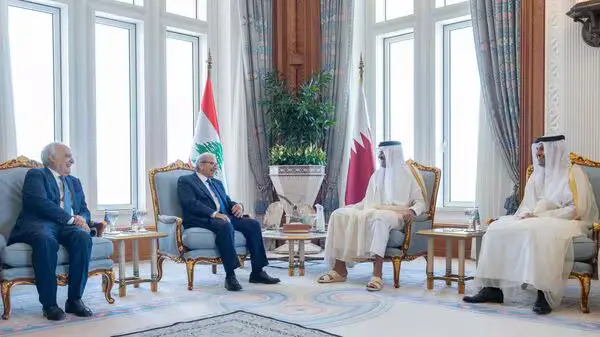
Iran-Israel Ceasefire: Discover how Qatar, a small but powerful emirate, has become a key mediator in international conflicts. From Gaza to Darfur, Qatar’s strategic interventions have shaped peace efforts across the globe, establishing it as a vital player on the world stage.
Iran-Israel Ceasefire: Qatar, an independent Arab emirate on the west coast of the Persian Gulf, intervened on behalf of the President Donald Trump-led US administration and persuaded Iran to agree to a cease-fire with Israel, the New York Times reported on Monday (local time).
Trump announced on social media that a cease-fire was imminent after 12 days of military actions between the two nations in the Middle East.
“President Trump spoke with Qatar’s Emir and informed him the US got Israel to agree to the ceasefire. The president asked Qatar to help persuade Iran for the same, following which vice president JD Vance coordinated with Qatar’s prime minister on the details,” news reports said.
Qatar’s Prime Minister, Sheikh Mohammed bin Abdulrahman al Thani, secured Tehran’s agreement to a US-proposed ceasefire in the conflict between Israel and Iran, Reuters said, quoting a senior official involved in the negotiations.
ndia welcomed the reports of a ceasefire between Iran and Israel and the role played by the US and Qatar in bringing it about, Ministry of External Affairs said.
This isn’t the first time oil-rich Qatar has stepped in to mediate a conflict. Since the 1990s, the Gulf nation of 3.15 million has built a global reputation for its role as a trusted intermediary. Not just in the Middle East but in far away African nations like Sudan.
Before the fresh wave of Iran-Israel conflict, Qatar had mediated the Sudan civil war, the US-Taliban deal, the Israel-Hezbollah agreement and almost came close to mediating the Russia-Ukraine war. The nation has had a significant role in resolving vulnerable hostage situations between the two nations by freeing prisoners.
Qatar’s mediation efforts extended to Chad, culminating in 40 opposition groups agreeing a roadmap to a national dialogue process in 2022. Also, Qatar, in 2023, hosted secret negotiations between the US and Venezuela, leading to a temporary suspension of US sanctions.
Qatar is a monarchy, ruled by the al-Thani family. The country is headed by an Emir – the ruler. The current Emir of Qatar is Sheikh Tamim bin Hamad al Thani. He ascended to the position in 2013, succeeding his father, Sheikh Hamad bin Khalifa Al Thani.
Qatar was the first Arab country to open a Trade Office for Israel following the Oslo agreement signed in the early 1990s for establishing peace in the Palestine-Israel region.
Since then, the rules of the monarchy have built the Gulf Nation’s foreign policy by forging alliances with dissidents, aiding revolutionaries and militant groups, and also playing a third-party mediator.
At the 77th UN General Assembly meeting in 2022, the then Emir Sheikh Tamim bin Hamad al-Thani stated that conflict mediation is a key element of Qatar’s foreign policy, aiming to establish the country as a dependable international ally.
Here is a look at five earlier conflicts in which Qatar played a mediator’s role:
Qatar used its soft power to let US leave Afghanistan after about two decades in the aftermath of 11 September 2001 attacks. Qatar’s involvement in facilitating the US -Taliban deal ended the nearly two decades of conflict in Afghanistan.
In 2013, Qatar allowed the Taliban to open an office in Doha. This was the Taliban’s first office outside Afghanistan after the US intervention. Qatar hosted several rounds of talks between the US and the Taliban to mediate the agreement signed on 29 February 2020, outlining the conditions for the withdrawal of US and NATO troops from Afghanistan in exchange for security guarantees from the Taliban.
Finally, the US left the country, and the Taliban took over Afghanistan in 2021.
Qatar facilitated a peace agreement in Darfur, Sudan, in 2011 and then again in 2020.
The 2011 Darfur Peace Agreement, also known as the Doha Agreement, was signed in July 2011 between the government of Sudan and the Liberation and Justice Movement. This agreement established a compensation fund for victims of the Darfur conflict, allowed the President of Sudan to appoint a vice-president from Darfur, and established a new Darfur Regional Authority to oversee the region until a referendum can determine its permanent status within the Republic of Sudan.
The Darfur peace deal, also known as the Juba Peace Agreement, was signed on 31 August 2020 in Juba, South Sudan. It aimed to end the long-standing conflict in Darfur. The agreement culminated negotiations between the Sudanese government and various armed movements from Darfur, including the Sudan Revolutionary Front (SRF).
The deal was signed years after the US-mediated deal of 2006 had collapsed.
Read the complete article here.
Conflict coaching is a fast emerging technique in the field of ADR. As a specialized process for helping individuals effectively engage in conflict, coaches assist individuals to determine what will...
By Cinnie NobleThe overconfidence effect is a natural bias toward believing that we’re better at something than we actually are. The overconfidence effect can distort belief in the accuracy of a strong...
By Tammy LenskiThis chapter is from "Online Dispute Resolution Theory and Practice," Mohamed Abdel Wahab, Ethan Katsh & Daniel Rainey ( Eds.), published, sold and distributed by Eleven International Publishing. The Hague,...
By Pablo Cortés