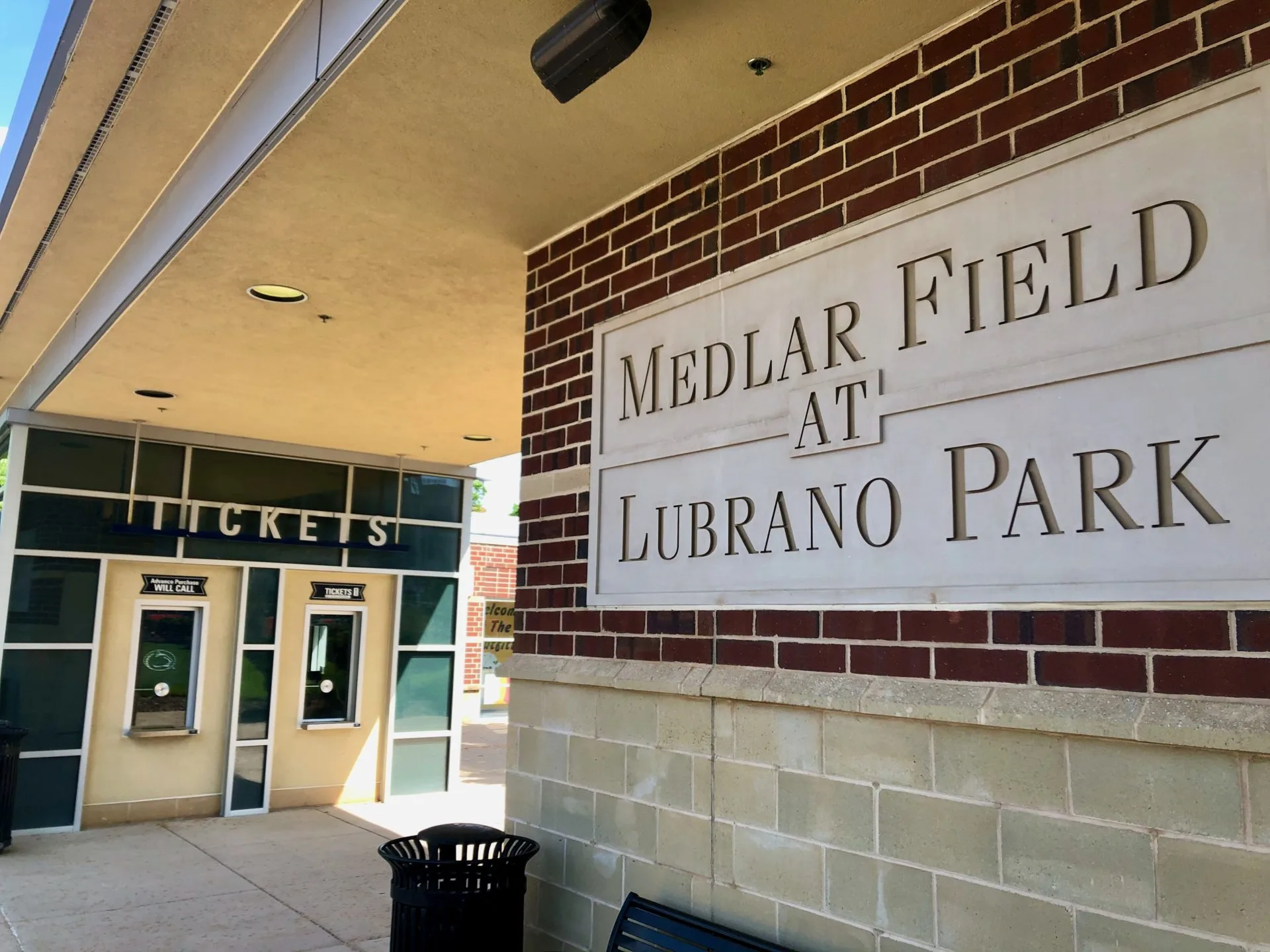
Penn State and the State College Spikes will enter mediation in an attempt to resolve the university’s lawsuit against the minor league baseball club over the team’s lease of Medlar Field at Lubrano Park, according to a document filed on Thursday.
Judge Brian Marshall ordered a stay in the case proceedings, by agreement of both parties, until mediation is completed on June 16.
Mediation involves a third party assisting the two sides in reaching a mutually acceptable resolution. It is not binding, and if unsuccessful the lawsuit will resume.
Marshall also noted in the order that the case will be transferred to another Centre County judge. The Spikes previously asked Marshall to recuse himself because his wife is a longtime employee of the university.
Penn State, which owns the ballpark on Porter Road and has rented it to the Spikes through a series of agreements since 2006, sued to evict the Spikes in early March after the university said the team failed to provide notice it would exercise a 10-year lease option when the previous term expired in September. A magisterial district in February granted the university possession of the property, but the Spikes appealed in the Centre County Court of Common Pleas, leading to Penn State’s filing of the lawsuit.
A university spokesperson said at the time that Penn State had repeatedly attempted to work with the Spikes on a new facility usage agreement, even after the litigation was filed, and that it remained willing to do so.
The Spikes organization responded that the lawsuit had “zero merit” and alleged that Penn State “has been engaged in a calculated effort to drive the State College Spikes out of business.
The team was required to notify the university by April 3, 2025 of its intent to re-up and Penn State informed the club on Aug. 18 that since it received no written notice to renew, the lease would terminate on Sept. 30.
According to the lawsuit, the Spikes insisted that they provided timely notice of renewal, and Penn State says it gave the team “numerous opportunities to provide proof,” to no avail.
On Oct. 1, Penn State posted notices on the ballpark for the Spikes to vacate the premises within 30 days, and when the club did not do so, the university filed a landlord/tenant complaint.
Penn State claims the Spikes also owe $1.7 million in termination rent, as well as $29,238 in unpaid rent installments through the end of the operating agreement.
In a subsequent filing, the university alleged that it has been keeping the team financially afloat for years through previously forgiven “significant” amounts of unpaid rent and overpayment for certain costs and fees as part of the shared use agreement. Penn State also claimed that the organization has not properly cared for the property, alleging the Spikes failed to clean bathrooms and dugouts, allowed dirt and bird waste buildup, and failed to repair cracks, leaks, an HVAC system in suites and a fire suppression system, among other issues.
The club said it has “operated the ballpark in exemplary fashion” and that “to portray the Spikes in the false light the university has concocted in an ever escalating attempt to force the Spikes out of business is reckless and should be beneath the university,”
Marshall did not rule on Penn State’s previous request to impose temporary operating guidelines for the shared use of Medlar Field while the case proceeds.
Despite the legal battle, the Spikes will play their 20th anniversary season starting in June, with 41 home games scheduled at Medlar Field.
Read the complete article here.
“I don’t want to resolve this conflict,” said the professor, looking me squarely in the eye and leaning forward in his seat. “I want to exacerbate it.” The word exacerbate...
By Tammy LenskiUtilizing the Historical Reasonable Person of Common Law Being reasonable, a criterion of common law, is used by many nations to conduct fair judgements and to safeguard communities from non-balanced...
By Alia IsmailWelcome to the Commercial Section. This section is devoted to the advancement of professional commercial mediation from the dual perspectives of both the consumer and of the practitioner. I anticiate...
By Tom Oswald