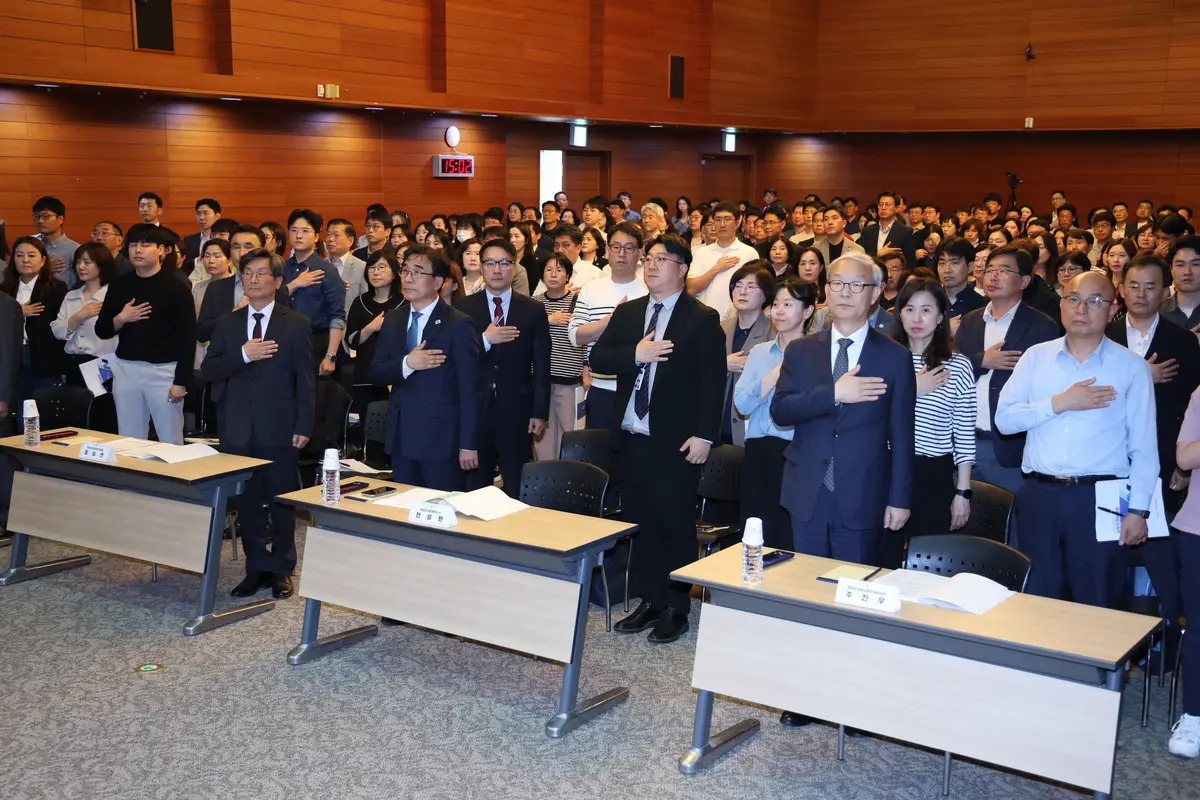
The Presidential Office and the Anti-Corruption and Civil Rights Commission (ACRC) held the “First Conflict Mediation Officer Workshop” on Wednesday, marking the full-scale launch of a government-wide response system to address conflicts and recurring grievances in citizens’ daily lives.
The workshop, held at Post Tower in Seoul, drew about 300 participants, including Jeon Sung-hwan, Senior Presidential Secretary for Public Engagement and Integration, and Jeong Il-yeon, Chairperson of the ACRC, along with conflict mediation officers from the central government, local governments, and education offices. The government recently designated “conflict mediation officers” at each agency to build an inter-agency cooperation system as recurring grievances and collective conflicts have become more complex and prolonged.
Each officer oversees the intake and handling of collective and unusual grievances within their agency, examines the root causes of grievances in advance, and supports conflict resolution through inter-agency consultation and on-site mediation. The officers also serve as on-site managers who coordinate and handle issues from the citizens’ perspective, preventing “buck-passing” between agencies and passive administration during the grievance response process.
Currently, 51 central government agencies and all 17 metropolitan and provincial education offices have designated conflict mediation officers. Among local governments, 145 agencies have completed the designation process. The government plans to have all local governments designate conflict mediation officers by the end of this month, establishing a nationwide conflict mediation response system.
The Presidential Office explained that the workshop reflects President Lee Jae-myung’s governing commitment to “treat citizens’ grievances as a treasure trove, listen to the public’s voice to the end, and resolve issues responsibly.” It also aims to embed the “governing philosophy of listening and communication,” which has been emphasized since the launch of the People’s Sovereignty Government, across all administrative agencies.
At the workshop, the key tasks presented included preventing recurring grievances in advance, responding swiftly to unusual grievances, strengthening on-site engagement, and building inter-agency cooperation systems. Through a cooperation framework involving the Presidential Office, the ACRC, and conflict mediation officers, long-unresolved grievances and collective conflict cases will be intensively managed, and each agency’s performance will be regularly reviewed to disseminate best practices.
“The President has repeatedly emphasized accountable administration that does not miss the golden time for resolving grievances,” Jeon said. “Preemptively resolving citizens’ inconveniences and conflicts is the starting point for restoring public trust.”
Read the complete article here.
Baltimore Injury Lawyer Blog by John BrattYou know what’s funny about stuff you post on the internet? It’s public, and that means people can see it. This includes those you...
By John BrattDistance Family Mediation by Susanna Jani Every summer, the Ladysmith Maritime Society in the pretty little town of Ladysmith on Vancouver Island holds a Purple Martin Open House. I had...
By Susanna JaniIt is uncertain whether, the Dodgers hopes of a winning season may have come to an end with the injury of pitcher Brad Penny. Why, because the Marlins may have...
By Elizabeth Moreno