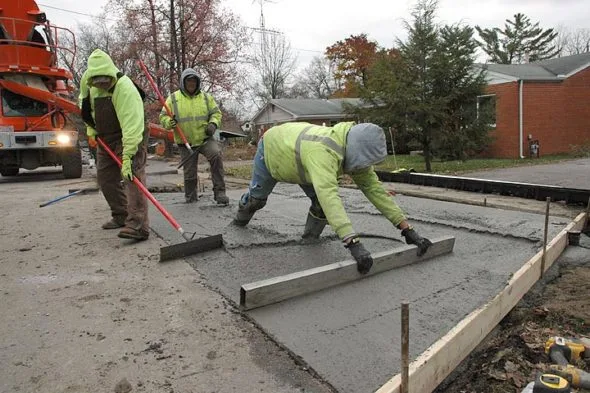
At the most recent regular Village Council meeting, Monday, May 18, Council members broached the possibility of changing a couple longstanding policies and programs — one being the onus of sidewalk maintenance and upkeep.
Though no decision was made on Monday, Council considered the implications of shifting responsibility for sidewalk repair and replacement from the Village to abutting property owners.
Such a move would reverse a 2011 ordinance that put the onus in the Village’s lap. Since then, the Village has spent $821,967 on sidewalk repairs, replacements, removals and extensions, according to a memo Village Manager Johnnie Burns shared with Council before Monday’s meeting.
That memo outlined three options for Council’s consideration:
• Option 1: The current policy remains and the Village retains full responsibility for all sidewalks throughout Yellow Springs;
• Option 2: Transition the responsibility back to property owners; or
• Option 3: Take a hybrid approach — one in which the responsibility is shared between the Village and property owners, with individuals handling day-to-day maintenance, and the Village “supports or cost-shares” major replacements.
Ultimately, Council decided not to take any of those options; the group went a fourth route, following a suggestion from Burns.
He recommended that Council continue thinking about their individual preferences, but to pause the conversation until later this year when the Village begins its budget planning for the upcoming fiscal year — particularly when staffers have a fleshed out capital improvement plan that details the costs of upcoming major projects, such as the cost of materials for sidewalk improvements.
All five Council members were amenable to that plan.
“We’re not saying this is off the table entirely,” Council President Gavin DeVore Leonard said. “We’re going to talk about it more when we talk about the capital costs of all our next projects.”
Before landing on that decision, Council members mused over the implications of burdening residents with the labor and costs associated with keeping up with the sidewalk in front of their homes.
“The red flag for me is the affordability issue,” Stephanie Pearce said. “How will this help the average resident in the community?”
Angie Hsu echoed those concerns.
“What are the options if it’s a cost that property owners can’t stomach? How is that decided and what is the redress for the people in that scenario?” she asked rhetorically.
DeVore Leonard pointed out that not every home in Yellow Springs has a sidewalk to maintain, and that, under the current model, those without sidewalks essentially subsidize those who do, albeit in the “public good,” as he called it.
“Do we need the money?” he asked. “If the sidewalks need to be maintained at whatever quality we expect, then someone is going to have to pay for it — the Village is going to have to administer some of it. So, I think it would really not make sense to have every homeowner do it independently, because we lose out on the economy of scale of doing it in chunks.”
Since 2018, the Village has consistently budgeted about $50,000 annually for sidewalk maintenance, and as Burns stated in the memo, he believes that amount has not been sufficient to “meaningfully address system-wide needs or keep pace with deterioration and replacement costs.”
Should Council decide the Village retain responsibility for all its sidewalks, Burns said the Village ought to begin allocating around $100,000 annually to “begin making measurable progress on backlog conditions.”
“Think about it this way,” he told Council members. “We are required to put in sidewalks if you build something new. Spring Meadows has new sidewalks, there will be a new one in front of the high school connecting Mary’s Way to Dayton Street, the multimodal path on Dayton Street … these are all now ours to maintain. Every time a sidewalk is added, you’re adding more labor and things for staff to do.”
Changes to Mediation Program?
Another potential shift coming down the municipal pike may be a restructuring of the Village Mediation Program, or VMP — Yellow Springs’ own community-driven conflict-resolution service, which has existed since its founding in 1989 as a mayoral initiative.
Historically, the VMP intervenes in civil and personal matters such as workplace disputes between employees and employers, neighborly disagreements and tenant-landlord conflicts. It’s a free service some seek, and for others, one to which they’re referred by the mayor or police.
According to a memo from Council member Carmen Brown that she sent her colleagues ahead of Monday’s meeting, she is recommending the dissolution of the program’s steering committee — a four-person group of villagers trained in mediation, to whom the VMP coordinator must report and consult, and which has also facilitated community forums in the past.
Longtime villager, psychologist and educator Brady Burkett has been the VMP coordinator since 2024. Under Brown’s proposal, Burkett’s position would change to director of the program.
Brown said in her memo that owing to Burkett’s “experience managing the program, a steering committee is no longer necessary for day-to-day operations, case coordination or program planning.”
“The VMP has served the Village for over 30 years, and while its mission remains important, the way mediation programs operate has changed over time,” Brown wrote. “As our expectations around confidentiality and program operations have evolved, it has become clear, in recent years, that the VMP would benefit from a more streamlined model that better represents how this work is done today.”
Ahead of Monday’s meeting, two steering committee members — Marianne MacQueen and Len Kramer —- wrote to Council saying that they were not consulted on the possibility of the group’s potential dissolution, and beseeched Council to consider the steering committee’s importance.
“In addition to providing confidential free mediation services to community members, over the years the VMP has hosted community trainings in conflict resolution, mediation, and facilitated numerous community forums,” MacQueen and Kramer wrote. “It has been able to do this because of the volunteers who have served as mediators, facilitators and Steering Committee members. There are a number of points of value to having this cohort of volunteers, not the least of which is spreading the capacity in the community to deal with conflict.”
The two committee members also challenged the notion that Council ought to be the deciding body about VMP operations. Brown, at Monday’s meeting, contended that Council does have the latitude to do so, given that the VMP is a taxpayer-funded service. In the 2026 budget, Council appropriated $14,420 for the program — mostly to cover Burkett’s stipend.
“I’m not a helicopter Council member. As long as people are saying the program is working, then I’m fine,” Brown said. “But when people say the program isn’t working in how it’s flowing, or how mediations are being handled, then it’s time to step in.”
Brown shied away from specifics, but said that she and Council member Pearce will soon meet with Burkett, Burns and the steering committee to consider the next best steps.
Read the complete article here.
"If you do what you've always done, you'll get what you always got." (Mark Twain) It is likely that you asked for or agreed to mediation because the strategies you...
By Tom SebokThis chapter is from "Online Dispute Resolution Theory and Practice," Mohamed Abdel Wahab, Ethan Katsh & Daniel Rainey ( Eds.), published, sold and distributed by Eleven International Publishing. The Hague,...
By Mohamed S. Abdel WahabFrom the Blog of Phyllis G. Pollack. On Sunday night (August 23, 2009), ABC TV aired the last prime time episode of “Who Wants To Be A Millionaire.” One of...
By Phyllis Pollack