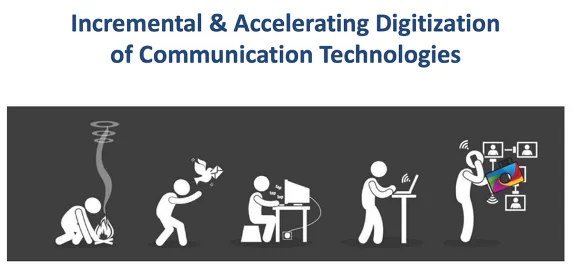
Along with ConflictNet’s and Mediate.com’s development beginning in the 1980’s, there were a number of more general “game changing” contextual technical developments that have successively changed things for all of us. Here is a quick recap:

The modern mediation movement began in earnest in the early 1980’s with the development of the “dedicated word processor” and the PC and Mac. This ability to endlessly edit limitless content was my first experience of just how much of a difference “technology” can be for a mediator. The ability of the mediator to efficiently edit correspondence and settlement agreements was a game changer for mediators and the nascent mediation industry.
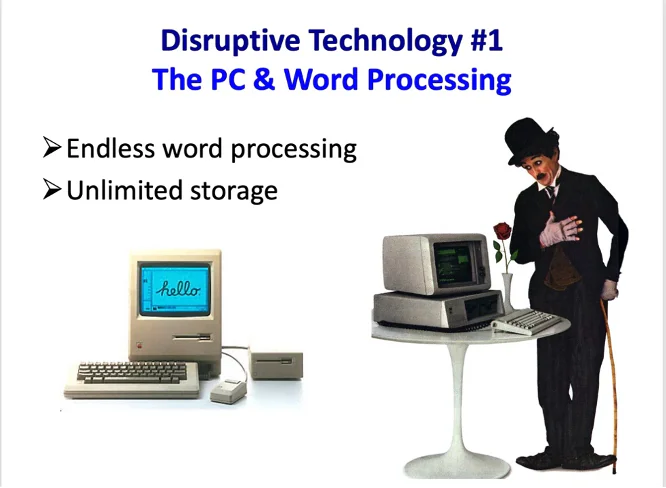
Dedicated word processors soon gave way to the development of the IBM PC and Apple Mac with ever-improving hardware and word processing software.

The next disruptive technology was the development of the Internet and, more specifically, the “World Wide Web,” with Internet browsers capable of sharing the full digital palate of text, image, audio and video communications. In time, mediators have also came to recognize the value of both “real time” (synchronous) communications and “asynchronous communications.” Each real time and asynchronous communications can also be either with parties jointly or respectively (caucus discussions).

With time, and rather remarkably, all of the computer functions previously on desktop and laptop computers have become available in the form of our iPhones and Android devices that not only fit easily into our pocket or purse (now making communications personal and private), but also, in time, these “phones” now have enough capacity to manage all of our text, image, audio and video communications, be those real time or asynchronous. Following on the heels of the word processor and personal computer, the mobility and personalization of digital “phone” communications have been a huge benefit for online mediation.
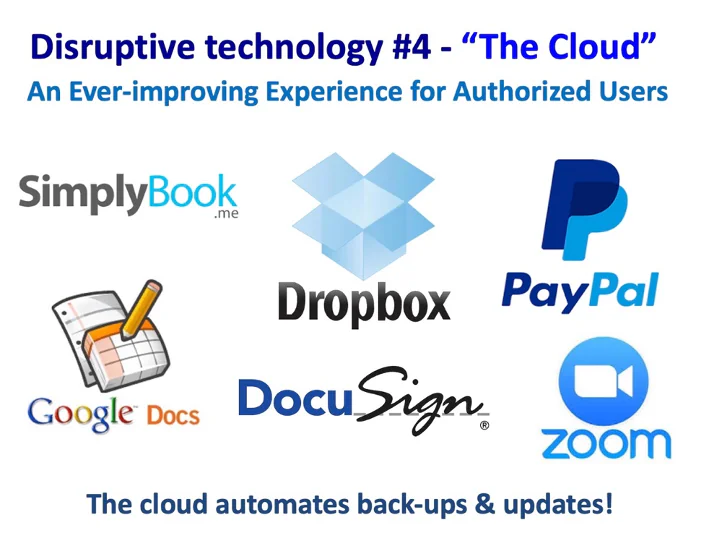
Other major technical developments over time have included “the cloud,” which substantially solved our software updating challenges and has also served to effectively “back-up” our data.
The Covid era development and rapid improvement and implementation of Zoom, along with such online meetings being rather effective as a physical meeting surrogate, has also been a massive boon for online mediation. The Covid pandemic, for online mediation, turned out to be, at least in part, a mass Zoom training event for both professionals and end-users (participants). While these things are hard to quantify, the Covid pandemic may well have expedited the development of online mediation by a decade or two.
In fact, through nearly 40 years of earlier incremental development, both the “front end” of a mediation (learning about mediation, finding a mediator, contacting and scheduling) and the “back end” (correspondence, drafting, signing) had already moved almost completely online before Covid. Mediators, lawyers and parties rarely send anything through the US Postal Service or even Fed Ex or UPS these days. Why not just send communication and resource online? Especially as platforms now exist to make those communications fully secure and confidential.
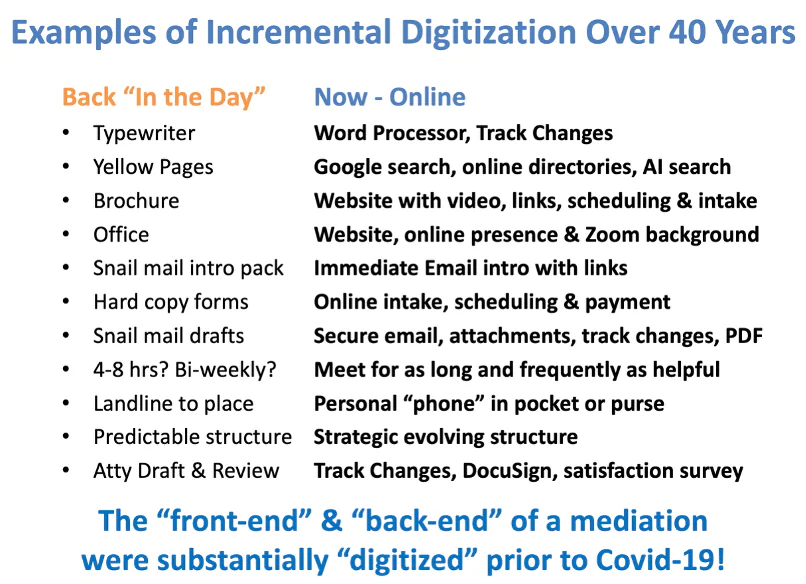
John Helie, my co-founder at Mediate.com, and I used to talk about whether the online environment would ever be “so good” as to “almost be as good as being there.” We wondered if the online environment would ever be so comfortable and effective as to actually be a preference for some participants, if not preferred by mediators and lawyers as well. We called this lofty goal “The Holy Grail.” Would we ever get there? Well, Covid and Zoom provided a remarkably clear and prompt answer.

Remarkably, with the onset of Covid and people’s inability to physically meet, both the private sector of mediation services and court mediation programs turned almost immediately to Zoom as a physical meeting surrogate. That was impressive, but what is even more impressive is that, now nearly 5 years later, between 70 and 80% of both participants and mediators PREFER to (and continue to) mediate online!
The elevated access to resolution provided by online mediation, at relatively low cost, is compelling. Rather than endlessly arguing “one’s legal case,” parties in online mediation have the ability to efficiently, affordably and directly resolve their substantive issues. With all decision-making in mediation being up to the participants, and with online mediation being fully confidential and secure, where nothing said will be held against any party if they do not settle, the online mediation option just makes sense. As already suggested, if people want to also physically together to discussion things, all the better . . . but that is still an “online case” where communications and final drafting and settlement will in fact take place online.
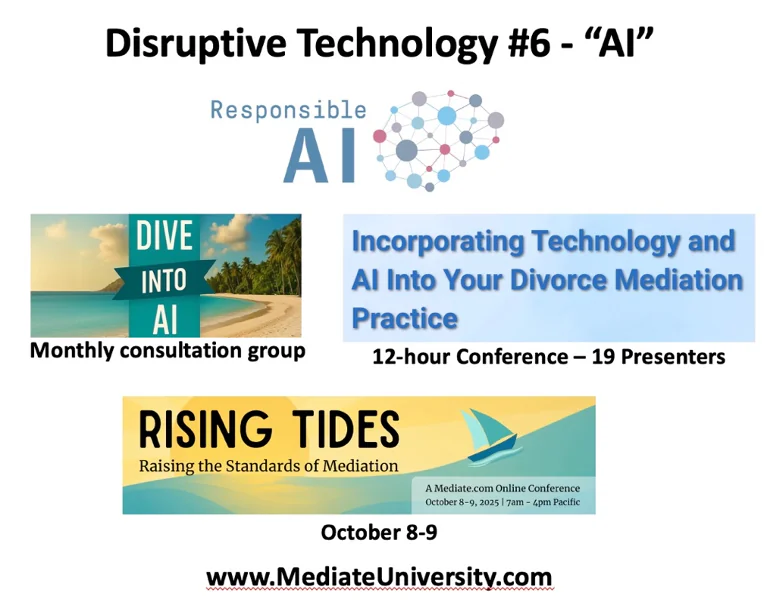
The final disruptive set of technologies is “AI” or “Artificial Intelligence.” Notably, while all of the preceding disruptive technologies over the past 40 years took huge steps toward comprehensive digitization of our communications (PCs/Macs, the Web, Digital Phones, the Cloud and Zoom), for the first time “AI” has the ability to go beyond improving our “digital plumbing” to, if desired, speak to any and, if desired, even ALL of the substantive issues of a dispute.
This is new and HUGE for the world of mediation, and for the world itself, in elevating our ability as mediators to assist mediation participants to both empower themselves with vital information and to also much more capably consider optimizing arrangements to resolve disputed issues. Ultimately, AI offers us the ability to create optimizing assistance to resolve both our and the world’s most vexing issues.
Before we fully plunge into the new and fascinating world of AI, let’s put a few more basic pieces in place regarding mediation.

The question whether mediation should be "fair" or "just" elicited the following thoughtful response from one of our attorney readers, who, as you can tell from the context, primarily represents plaintiffs...
By Victoria PynchonHow dispute resolution can help when the courts can’t There appears to be a gradual change from so-called “vanilla” relationships to throuples or polyamorous relationships. These are not only causing...
By Keri Morris"I’ve explained it all to my client. We can dispense with your opening statement and get down to business." Every mediator on occasion has heard this first-shot-out-of-the-cannon remark. The speaker,...
By Edward P. Ahrens