By Robert Bergman, Southwest Management Technology
INTRODUCTION
For most of the past decade, generative AI advanced on a simple recipe: make the models bigger, feed them more text data, and buy more computing power. The recipe worked so reliably that it acquired the name, the scaling laws. Then an industry built trillion-dollar plans around it. But recipes depend on ingredients, and several of the key ingredients are now running short. The question is no longer whether generative AI will keep improving, but what will constrain how fast, what cost and how it will be governed.
SYSTEM VIEW OF GENERATIVE AI EVOLUTION
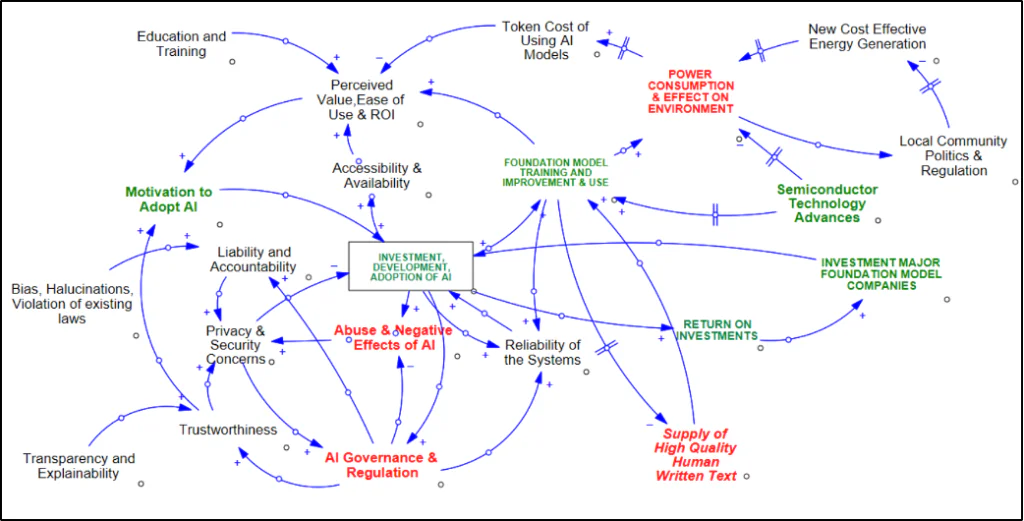
General Limitations of AI Growth
Large language models are trained on text, and the supply of high-quality human-written text is finite. Researchers at Epoch AI (a company that collects data on AI growth) have estimated that if current training trends continue, models will exhaust the stock of useful public text sometime between 2026 and 2032. The highest quality portion sooner than that. The industry’s main workaround is synthetic data: text generated by models to train other models. This works well in domains like mathematics and code, where answers can be automatically verified. Elsewhere it is riskier. Models trained heavily on their own outputs tend to lose diversity and, in the extreme, degrade. This is a failure mode researchers call model collapse. Data is not gone as a resource, but the era of free, abundant training material is ending.
Energy Constraints to Growth
The binding constraint of the moment is not silicon but electricity. Modern AI data centers demand hundreds of megawatts per site, and global AI computation now consumes electricity on the scale of a mid-sized European country. Grids were not built for this. Connecting a new 500-megawatt facility can take years of permitting, transformers, and transmission lines, and utilities in several regions have begun turning projects away. The major AI companies have responded by becoming energy companies of sort. They are contracting for dedicated gas plants, batteries, and even nuclear reactors. That buys capacity, but on the timescale of power infrastructure, which is measured in years, not product cycles.
In addition, as AI data centers expand to meet growing demand for computing power, they are increasingly encountering resistance from local communities. Residents are raising concerns about rising electricity costs, heavy water consumption for cooling, noise, land use, and the relatively small number of permanent jobs these facilities create. In 2026, several high-profile
projects have been delayed, scaled back, or canceled following organized local opposition and legal challenges, reflecting a broader trend in which communities are demanding greater transparency, stronger environmental protection, and clearer evidence that the economic benefits outweigh the local costs. A notable example is the collapse of the Digital Gateway data center project, by Blackstone QTS, in Prince William County, Virginia.
Diminishing returns on scale
Even where data and power are available, the mathematics of scaling is unforgiving: each doubling of compute yields a smaller improvement than the last. Training runs for frontier models are projected to cost several billion dollars each, and those costs must eventually be recovered from customers. The industry has partly sidestepped the problem by shifting from bigger training runs to smarter inference, basically letting models “think longer” on hard problems. However, that just moves the expense from training to everyday use, where it
compounds with every query.
Economic Limitations
AI adoption is now widespread across industries, although in many cases it remains relatively shallow. Organizations are experimenting with copilots and automation, yet far fewer have fundamentally redesigned how work gets done. I am reminded of companies that eagerly buy sophisticated equipment only to discover months later that their processes have barely changed. If revenue continues to lag behind infrastructure investment, capital is likely to become
a more significant constraint. Investors are already placing greater emphasis on measurable business outcomes rather than AI deployment alone, and if that trend continues, the availability of funding may prove to be one of the most important limits on AI’s long-term expansion.
WHAT DOES GLOBAL AI GOVERNANCE REALLY LOOK LIKE?
The real governance problem of AI is not that no one is in charge, but that we keep looking for someone to be in charge of a system that can only be steered from within.
As mentioned in a previous article, technology develops at the pace of engineering. Society adapts at the pace of culture. Regulation moves at the pace of politics. This sequence appears across automobiles, aviation, telecommunications, the internet, privacy, social media, and now AI. Scholars argue that regulation is typically driven less by the invention itself than by broad social acceptance and the emergence of significant societal consequences.
Notice the structure of the AI System. The engine at the center is a set of fast reinforcing loops, adoption feeds model improvement, which feeds perceived value and ROI, which feeds investment and more adoption. These loops turn in months. Every balancing force in the diagram is slow: power infrastructure and local politics (delayed), new energy generation (delayed), semiconductor supply (delayed), and regulation responding to abuse, privacy concerns, and trust erosion, which reacts to harms only after they’ve occurred and diffused. Fast reinforcing loops governed by slow balancing loops is the classic recipe for overshoot:
Current governance is built on a regulatory template borrowed from product safety: classify the artifact, assess its risk, certify it, then punish misuse. That works for technology, not the system of adoption. As one can see from the diagram, regulation is only one node in the system of AI adoption.
The EU AI Act is the best example of the problem with the current approach. The act works for governing technology. However, as the diagram above demonstrates, the thing that needs governing is a system of adoption driven by feedback loops, which the product-safety approach barely addresses. It regulates nodes (models, applications, deployers) while the dynamics live in the loops, investment racing ROI, adoption outrunning trust, energy demand outrunning grids, data depleting silently. None of the current frameworks even measure those loops, let alone tune them.
The deeper mismatch is politics. Legislation is a slow balancing loop by construction, years to draft, more years to enforce, static once written. Pointing it at a system whose reinforcing loops turn in months guarantees it regulates last year’s system. The EU wrote rules for foundation models that were partly obsolete before the compliance deadlines arrived.
What’s missing is governance of the system itself. That requires four things we don’t have today:
Until these four exist, AI governance will remain a collection of local fixes applied to a global dynamic
WHAT ABOUT THE ENTERPRISE?
Enterprise AI governance is the missing middle layer in this whole picture, and it maps onto the same loop structure, just on a smaller scale.
Inside a company, the pattern repeats almost exactly. There’s a fast-reinforcing loop: employees discover AI tools, get value, use them more, tell colleagues. And there’s a slow balancing loop: the governance committee, the acceptable-use policy, the legal review. The gap between them produces “shadow AI” the enterprise version of the overshoot in the diagram. Employees adopt at product speed; the policy arrives quarters later, describing tools people have already moved past. Most enterprise governance discussions are really about this speed mismatch, even when they’re framed as being about risk categories or approval workflows.
The enterprise is both a miniature of the governance problem and a component of its solution.
It’s the one place where policy, tooling, and adoption meet in the same room, which is why, practically, most AI governance that happens in the next five years will happen there, not in legislatures.
ADDRESSING THE GOVERNANCE PROBLEM
Southwest Management Technology’s PII Anomalyzer fixes one specific failure point in the AI adoption system: personal data leaking into AI tools before anyone can stop it. The application detects and removes names, Social Security numbers, medical records, and 50-plus other types of personal information from documents, entirely on your own computer, with nothing sent to the cloud. This way sensitive data is protected before it ever reaches foundation AI models like ChatGPT, Claude, or any other AI system. This matters for governance because
it inverts the usual model. Traditional regulations are slow and reactive: harm occurs, trust erodes, rules follow years later.

Mediation is, by its nature, a reflective profession. It asks practitioners to hold space for others, to manage complexity, and to navigate human conflict with care, neutrality, and discipline. Yet,...
By Stuart HansonFrom the Blog of Phyllis G. Pollack. As many of my readers are aware, I mediate “lemon law” cases or matters brought under California’s Song-Beverly Consumer Warranty Act (Civ. Code...
By Phyllis PollackThis article is republished with the permission of the CPR Institute for Dispute Resolution from the January 1998 issue of Alternatives. 1998 CPR Institute for Dispute Resolution.
By John Lande