Historical Perspective
Technology develops at the pace of engineering. Society adapts at the pace of culture. Regulation moves at the pace of politics.
A recurring conclusion in technology policy literature is that regulation tends to move through three phases:
This sequence appears across automobiles, aviation, telecommunications, the internet, privacy, social media, and now AI. Scholars argue that regulation is typically driven less by the invention itself than by broad social acceptance and the emergence of significant societal consequences.
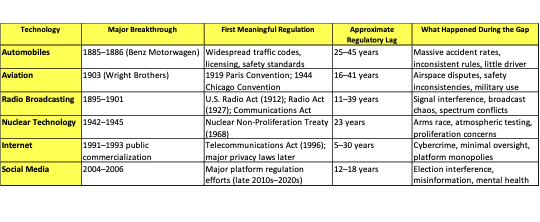
On the predictable lateness of rules
The structural explanation: There is a name for this pattern of dragging our feet to regulate new technology, it’s called the Collingridge dilemma. The philosopher David Collingridge described it in 1980 and the dilemma has since carried his name. Early in a technology’s life, when changing course would be easiest, no one yet understands enough to write rules that wouldn’t choke off the good with the bad. By the time the understanding arrives, technology is too embedded in the economy, the supply chain, and ordinary life to be meaningfully restrained. The window of competence and the window of leverage barely overlap. Cars, asbestos, leaded gasoline, social media, and now generative AI all trace the same curve. We do not arrive late because we are slow. We arrive late because the structure of the problem all but guarantees it.
The political economy explanation: The industries that profit from new technology have concentrated, organized, well-funded interests; the diffuse public has none of those. Lobbyists keep regular office hours. The affected public shows up only after the harm has been done . A regulator deciding whether to act in year one of a new technology faces a room full of well-prepared advocates explaining why intervention is premature. The future victims, who do not yet know they are future victims, send no representatives. The asymmetry is not a bug in the system. It is the system.
The disaster reflex explanation: Legislation in a democracy, as a rule, follows disaster rather than precedes it. The SEC arrived after 1929. The FDA’s modern teeth arrived after thalidomide. OSHA arrived after a wave of industrial deaths. GDPR arrived after Snowden and Cambridge Analytica. The pattern is consistent and instructive: political will requires public attention, and public attention requires a vivid, identifiable harm. No harm, no rule. Humans learn by autopsy. A quote widely attributed to Albert Einstein: “Technology advances faster than our humanity”.
The trouble with generative AI is that the autopsies will be quiet: a privileged document slipped into a training corpus, a private medical record surfacing in someone else’s chatbot completion, a deepfake deposition that no one knew to challenge. Quiet disasters do not drive legislation. They unfortunately accumulate.
Why we should not wait for comprehensive governance
If history is any guide, comprehensive AI regulation will arrive late, fragmented internationally, and badly drafted, after several preventable harms have already become irreversible. The rational response to this prognosis is not despair or anger; it is also not patience. It is to take the small actions that lie within reach now, before the rules arrive, rather than to wait for institutional rescue that the institutions themselves cannot yet provide.
Privacy is the most immediate of these. Every document fed into a generative AI system is a small, often invisible donation of personal information into an infrastructure no government fully governs, and no user fully sees. This is the gap PiiAnomalyzer was built to close, to strip identifying details out of documents before they leave the user’s control, so the benefits of AI can be captured without quietly trading away the private data of clients, patients, and employees. It does not solve the governance problem. It simply refuses to wait for it.

This article appeared in the winter 2013 issue of Family Law News, published by the Family Law Section of the Virginia State Bar Association.Consider this. After twenty years of marriage,...
By Rachel VirkJuliana Birkhoff describes a shift in her goal of making peace in the world to her satisfaction with making more incremental progress.
By Juliana E. Birkhoff Ph.D.Kluwer Mediation BlogIt’s not always easy to spot trends. But one that I have noticed over the last year or two is an increase in the number of cases I...
By Bill Marsh