There is much research demonstrating concerns about how AI can hurt us emotionally – information overload, loss of autonomy, dehumanization, and concerns about whether to trust it can all lead AI users to feel a sense of overwhelm and fatigue.[i] These impacts are often cited as reasons to be concerned or to avoid using AI, or at the very least to be more careful with its use. This article does not dispute these problems and drawbacks of AI use – rather, it seeks to make the case that there are some new things AI can do (beyond merely increasing efficiency, speed, and accuracy) that can help human beings emotionally in ways that people often cannot.
In some cases, AI may be able to intervene when there is something too traumatizing for humans. As one example, Facebook’s employees in charge of monitoring content for violence and hate described themselves as being traumatized by the content they were seeing.[ii] When Facebook announced the use of AI moderation in March 2026, they described how new systems could work 24/7 and were smarter.[iii] They did not emphasize another key emotional benefit – the AI is sparing people from doing jobs that hurt them emotionally.
Another similar, and perhaps more common, application is to allow people to vent and seek support, as was demonstrated in a study of 394 frontline hospital employees who used AI outlets for venting channels when they were emotionally exhausted (seeing them as “low-risk, immediate, and non-judgmental emotional outlets when facing resource depletion”).[iv]
John Lande is a proponent of the dispute resolution field’s use of AI, having created a CustomGPT in ChatGPT called the Real Practice Systems Negotiation and Mediation Coach (RPS Coach). RPS Coach is a ChatGPT interface trained to use Lande’s voice and draw from his writings.[v] There are many benefits to using this AI, including in dispute resolution education. Lande’s article about “Faculty Use of Artificial Intelligence in Teaching” summarizes 63 responses about the benefits and risks of AI in classroom settings.[vi] Respondents discussed efficiency, accuracy, integrity – the standard arguments people often make about the benefits of AI. Some people also warned of inefficiencies and inaccuracies – laziness, cognitive offloading, and hallucinations.[vii] But what about how AI can help us emotionally?
Beyond the aforementioned extreme Facebook example warning of the emotional damage engaging with graphic content, there are many mundane day-to-day tasks that can become emotionally difficult and lead to bias. Lande wrote about this in a blogpost pitching that educators use the RPS Coach AI in grading, suggesting it can spare professors from stress and bias:
“Grading is time-consuming, especially when you want to give thoughtful, individualized feedback – or feel like you should. It’s mentally exhausting. By the fifth paper, everything starts sounding eerily like your first. Or like a message from a bot in a parallel universe. You wonder if you inhabit the same universe as your students. It’s emotionally draining. You feel grumpy and you can’t help but take it out in the grades on the later papers.” (http://indisputably.org/2025/04/how-you-can-survive-grading-season-with-a-little-help-from-your-friend-rps-coach/)
He concludes that AI could help produce grading that is “less bitter – than whatever you would write at 2:00 a.m. in a daze of despair, surrounded by a pile of dried-out pizza crusts.”
In other words, AI can step in to help when faculty hit a mental emotional roadblock intrinsic to a draining task itself, or during a time where some exogenous distress (or disability limitations) have compromised their faculties.
Dan Berstein, a mediator with bipolar disorder and co-author of this article, has been experimenting with ways using AI can reduce emotional distress, following a vision he first shared at Mediate.com’s AI conference in 2023.[viii] During that “AI Bias and Awareness” presentation, while raising concerns that AI models were showing stigmatizing and discriminatory biases about mental illness, Dan also shared his hopes for using AI to reduce emotional burdens.
The chart below shows what Dan presented at the conference in 2023 and how he has used AI now, in 2026, to address these issues. The first two columns are direct quotes from the 2023 presentation slides, and the third column describes how Dan uses AI now in 2026.
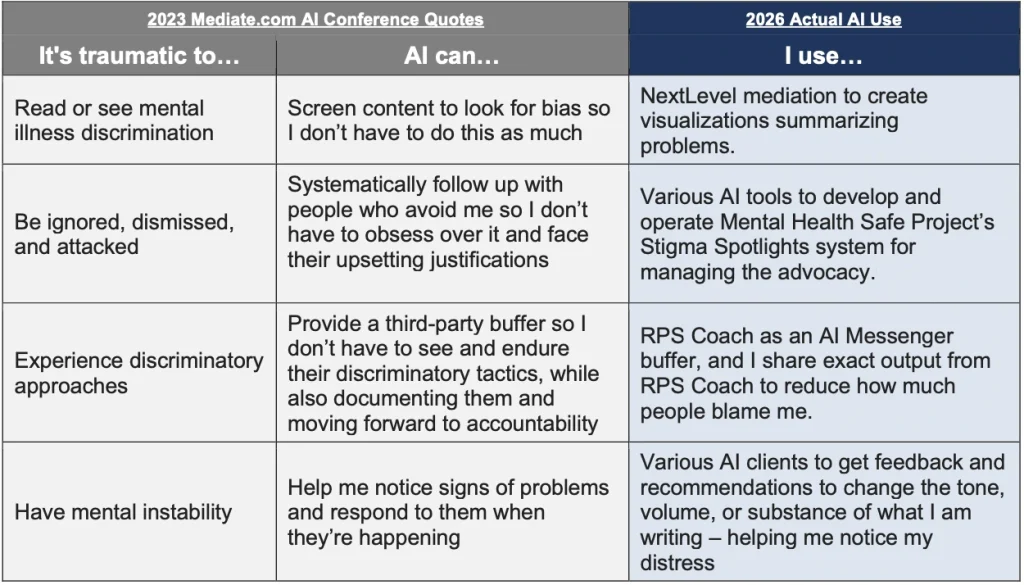
AI also allows for communication that otherwise would not exist because the people involved are emotionally taxed.
There are some conflicts where communication breaks down and it is not possible for parties to connect. Through the Mental Health Safe Project, Berstein works to get organizations to update or remove potentially stigmatizing or discriminatory guidance about mental illness.[ix] Some organizations have negative reactions, and they even avoid communication, making it hard to move forward. Berstein has used NextLevel Mediation software to approximate their feedback and perspectives so he can incorporate their points of view and move forward even if they are no longer available to engage and answer questions, as he describes in the case study below:
Conflict Stories Case Study: Learning From Absent Parties [x]
“There was one organization that wrote to me sharing a false story that I had attempted to fly to one of their programs and potentially harm them. I replied offering to clear this up. Beyond the fact that it was made up, I also explained that it was not realistic (due to limitations from my mental illness, I do all of my work virtually and I do not fly). They did not answer and I was left on my own trying to figure out how to clear my name in the community. I went back over my e-mail history with them, downloaded documents of full e-mail conversations, printed them out as PDF files, and uploaded it all to NextLevel Mediation’s software. This meant I did not have to go through the traumas of re-reading and re-living everything because I could trust the AI to look through it.
NextLevel Mediation can do all sorts of powerful analysis and visualizations, but it occurred to me that the way it was parsing the conflict was supportive to my viewpoint. Even though I felt sure I was right, I also wanted to know why this organization might believe I am wrong, so I can learn ways to improve my advocacy and meet them where they are at. Ordinarily this would be impossible without their engaging in dialogue. However, I was able to use NextLevel Mediation to approximate their views in ways a human being could not. I gave it the following prompt:
From there, NextLevel generated full charts showing me what their harshest views might be of me, citing the quotes from their exact e-mails it drew from. Here is a de-identified list:

I was able to keep engaging with AI in this way to bring my attention to concerns and issues I otherwise would not have been able to access given their lack of communication. And I was able to repeat this process with some other dead ends – people who had rejected, stigmatized, or avoided me – so that way I could figure out ways to move forward and reorient. [xi]
A Note About Consent
When authoring this article, we discussed how inputting correspondence with another person into an AI may raise issues of their consent to the information being included for an AI analysis. Much has been written about the copyright concerns that come from AI models being trained on, and extrapolating from, legally protected works. There are also legal privacy concerns when it comes to protecting the confidentiality of information that ends up inputted into AI models.
A mediator or conflict coach likely assumes a contractual duty to protect party confidentiality and thus should ensure consent before inputting any of their data into AI. In day-to-day life, like the aforementioned example from Dan, personal correspondences do not typically come with a duty for confidentiality.
A best practice may still be to let people know that you are using AI for help. For the aforementioned example, the specific use of the AI was in place of continued contact so there was no way to let the organization know the data from their e-mails were being used.
AI can be therapeutic and supportive, absorbing emotional problems in ways that would not only be impossible for a human being, but that may also cause them vicarious trauma from being exposed to both the overwhelming content being shared and to witnessing another person engage in decompensating behaviors.
The Job Accommodation Network (JAN) is a free, confidential service provided by the U.S. Department of Labor’s Office of Disability Employment Policy (ODEP). They provide resources to help people with disabilities pursue disability accommodations, and help employers understand their responsibilities and options. A JAN article on how AI impacts workplace accommodations details a wide variety of ways it may be used to help with accessibility, executive functioning, communication, and more.[xii]
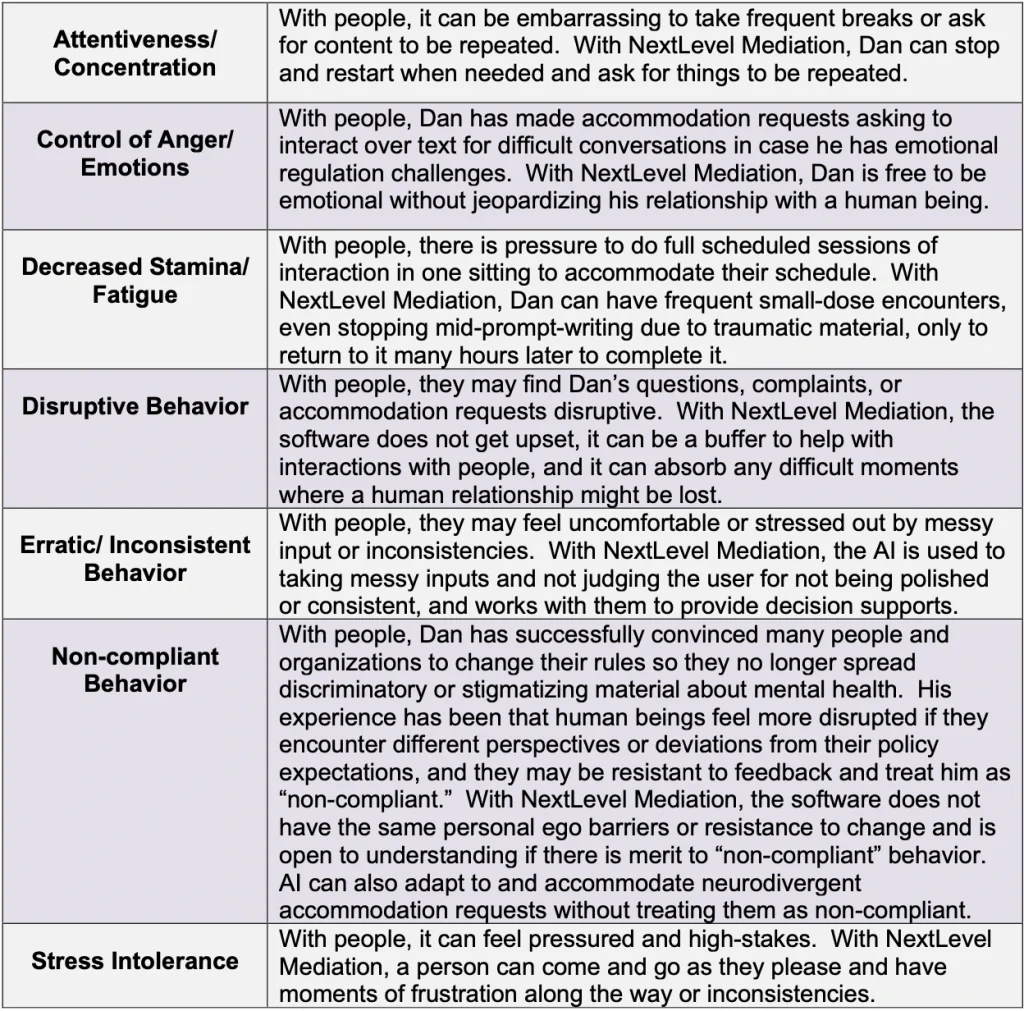
As an illustration of some ways AI can help, co-author Berstein has created the chart below showing ways his disability of bipolar disorder was accommodated by NextLevel Mediation’s AI, which provided him therapeutic benefits by allowing him a platform to manage his feelings without bothering another person.
Below is a list of possible disability limitations which may lead a business to provide workplace accommodations to someone with Dan’s disability of bipolar disorder. The list is based on JAN‘s list for bipolar disorder.[xiii] For each listed disability limitation, Dan has shared how NextLevel Mediation has helped him:
Below is a graphic of a causal loop model developed by Bob Bergman to help explain how AI-mediated emotional regulation works best during high-stress work. It illustrates how helpful it can be to reduce the emotional load and increase the capacity to deal with problems – unless there is an overreliance on the AI, leading people to lose their own abilities and become more dependent on the AI. The takeaway is to use the AI appropriately without burning your human bridges. When AI helps, it reduces load and boosts capacity (R1). But if reliance grows, it can erode capacity over time (R2), which pushes more AI use. Relationship strain is still moderated by AI (B1), but people should make sure not to “burn their human bridges”:
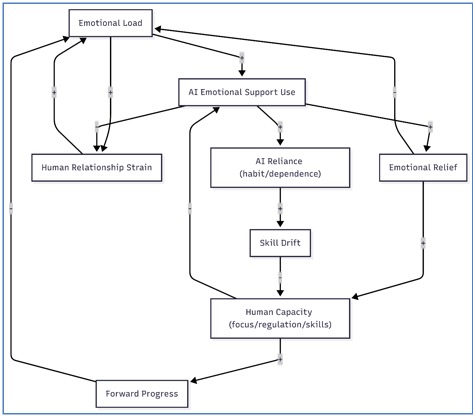
This causal loop diagram illustrates how AI functions as emotional infrastructure in emotionally demanding work. When emotional load increases, people are more likely to use AI for emotional support, which provides emotional relief and restores human capacity such as focus, regulation, and cognitive stamina. Increased capacity enables forward progress, which reduces emotional load, creating a reinforcing loop that stabilizes functioning during stress.
AI use reduces strain on human relationships by absorbing emotional intensity and preventing interpersonal overload, which helps keep emotional load from escalating further. However, the diagram also captures a potential risk: sustained reliance on AI can lead to gradual skill drift, reducing human capacity over time and increasing dependence on AI, forming a secondary reinforcing loop.
Together, these interacting loops show AI as both a short-term stabilizer that preserves functioning and relationships, and a system that requires mindful use to avoid long-term erosion of human capacity.
AI can help beyond efficiency reasons. It can be therapeutic, and enable progress that may not otherwise be possible due to emotional blocks. If you would like to share your experiences about how you are using AI to help you during times you find something emotionally stressful or taxing to do, please fill out this quick, qualitative, anonymous, 1-question survey (https://forms.gle/A6d2cREKLm2GVcdp7). This can help us continue to document ways AI helps people emotionally. You can also access more resources related to the emotional use of AI at www.mhsafe.org/ai, a website created by Berstein’s Mental Health Safe Project to help people respond to advocacy-related stigma, rejection, and trauma through the use of AI tools.
[i] Turki, A. M., & Triki, M. (2025). Between cognitive overload and dehumanization: Exploring the dimensions of consumer fatigue with artificial intelligence. International Journal of Research and Innovation in Social Science (IJRISS), 9(10).
[ii] National Public Radio. (2019, July 1). For Facebook content moderators, traumatizing material is a job hazard. NPR. https://www.npr.org/2019/07/01/737498507/for-facebook-content-moderators-traumatizing-material-is-a-job-hazard
[iii] Meta. (2026, March 20). Boosting Your Support and Safety on Meta’s Apps With AI. Meta Newsroom. https://about.fb.com/news/2026/03/boosting-your-support-and-safety-on-metas-apps-with-ai/
[iv] Cheng, J., & Jiang, J. (2026). Customer Mistreatment and Venting to Conversational AI: Emotional Exhaustion as Mediator and Trust in Conversational AI as Moderator. Behavioral Sciences, 16(4), 520.
[v] Lande, J (2026). The Real Practice Systems Negotiation and Mediation Coach. Available at https://mediate.com/RPS-Coach/index.html
[vi] Lande, John, Faculty Use of Artificial Intelligence in Teaching (October 13, 2025). University of Missouri School of Law Legal Studies Research Paper No. 2025-48, Available at SSRN: https://ssrn.com/abstract=5598157 or http://dx.doi.org/10.2139/ssrn.5598157
[vii] Strong, S.I., Artificial Intelligence in Civil Justice Systems: An Empirical and Interdisciplinary Analysis and Proposal for Moving Forward (May 02, 2025). Emory Legal Studies Research Paper, 41 Ohio State Journal on Dispute Resolution (forthcoming 2026), Available at SSRN: https://ssrn.com/abstract=5239069 or http://dx.doi.org/10.2139/ssrn.5239069
[viii] Mediate.com (2023). Artificial Intelligence (AI) and Mediation Conference. Available at https://mediate.com/ai/
[ix] Visit www.disabilityradar.com/about to see some examples of these changes.
[x] This example is linked to a specific situation Dan has spoken about as part of the Conflict Stories podcast, with the episode available at http://www.danberstein.com/conflict-stories
[xi] For more examples of a model for responding to rejection by respecting someone’s decision not to engage, and looking for ways to reorient, see Berstein, D. (2025, February 12). Written Off: Three steps to Move forward when you feel rejected. The Australian Dispute Resolution Research Network. https://adrnetwork.blog/2025/02/13/written-off-three-steps-to-move-forward-when-you-feel-rejected/
[xii] Job Accommodation Network. How artificial intelligence impacts workplace accommodation. (n.d.). https://askjan.org/articles/How-Artificial-Intelligence-Impacts-Workplace-Accommodation.cfm
[xiii] Job Accommodation Network. Bipolar disorder. (n.d.). https://askjan.org/disabilities/Bipolar-Disorder.cfm


Important Updated Information: Jeffrey Lee Krivis: March 8, 1956 – August 23, 2024 Jeffrey Lee Krivis, age 68, of Tarzana, California passed away on Friday, August 23, 2024. A funeral...
By Jeffrey KrivisA) Introduction This article rebuts “Reclaiming Mediation’s Future: Getting Over the Intoxication of Expertise, Re-Focusing on Party Self-Determination,” written by Robert A. Bush and Joseph P. Folger in 2014 for...
By Sam ImperatiFirst, let me confess a bias, which after all is nothing more than a leaning in a particular direction. When I first started in mediation, I listened to everyone who...
By Charles B. Parselle, Jeffrey Krivis