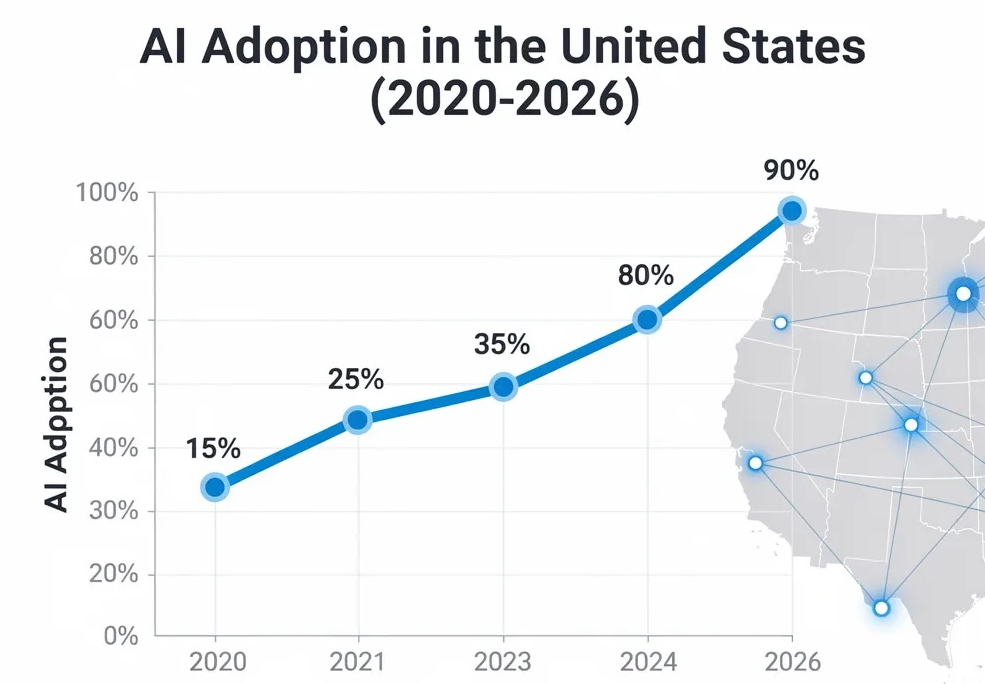
In the past few years, artificial intelligence has moved from being a speculative buzzword to something that quietly hums behind customer service chats, medical scans, logistics software, even the playlists we swear feel personal. It is everywhere. Or at least it feels that way on some mornings when I open the news and see yet another headline about automation replacing tasks that once seemed permanently human. The speed of AI adoption across sectors has ignited a serious debate about its economic consequences, and not the polite kind. Some hail it as salvation for stagnant productivity. Others warn of instability, even collapse.
The truth probably sits somewhere in between, though it does not always behave politely. AI undeniably holds the capacity to transform industries. It can enhance efficiency and drive innovation. It can reduce errors and costs in ways that make spreadsheets glow with promise. Yet its rapid integration also threatens to create disruptions that, if poorly managed, may destabilize economic systems that already feel stretched thin. When we examine this through the lens of a causal loop diagram (see below), the picture becomes more intricate, because each cause and effect has its own lag time), almost like watching ripples in a pond that do not stop when and where you expect them to.
The Dynamics of Rapid AI Adoption
When firms adopt AI quickly, the initial gains can be dramatic. Productivity climbs. Operational expenses shrink. Executives celebrate, investors nod approvingly. But beneath those improvements sits a more complicated reality. AI systems, particularly in data processing, manufacturing automation, and increasingly in knowledge work, can replace certain forms of human labor. That replacement is not theoretical. It is happening now, in logistics centers and call centers and software departments.
I remember speaking to a friend who works in supply chain analytics. He told me, with a shrug that tried to seem casual, that half his team’s forecasting tasks are now automated. “It’s faster,” he admitted. “And weirdly more accurate.” He said this while staring at his coffee like it might argue back.
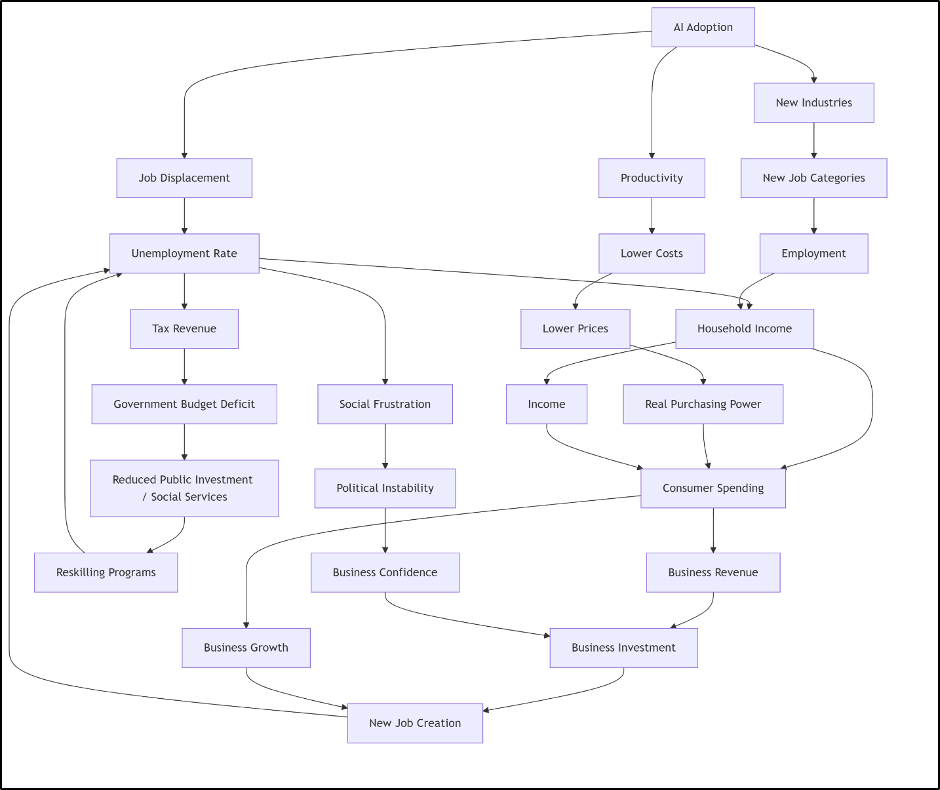
Causal loop analysis suggests that rapid displacement can trigger
reinforcing mechanisms. And reinforcing does not always mean beneficial.
Reinforcing Negative Loops
Demand Collapse Loop
As AI adoption rises, job displacement can push unemployment upward. Higher unemployment reduces household income. Reduced income dampens consumer spending. That decline in demand lowers business revenues, which then discourages investment and slows job creation. The cycle tightens, like a belt pulled one notch too far.
It is tempting to imagine markets adjusting smoothly, like a thermostat correcting room temperature. But economies are not thermostats. They are more like weather systems. A drop in consumer spending can cascade. If left unchecked, such a loop could spiral toward recessionary conditions. The International Monetary Fund has, in recent reports, cautioned that uneven technological transitions can intensify inequality and suppress aggregate demand in the short term. That warning feels less abstract when one considers how quickly entire roles can vanish.
Fiscal Strain Loop
Unemployment does not only affect households. It also erodes tax revenues. Lower income taxes, reduced payroll contributions, weaker consumption taxes. Governments may then face widening budget deficits. In response, public spending can contract, including funding for workforce development and reskilling programs. Ironically, those are precisely the investments needed to help displaced workers transition.
There is something almost tragic about that feedback loop. A society needs more training at the exact moment it has fewer resources to provide it. The World Bank has emphasized the importance of human capital investment during technological transitions, noting that failure to do so can prolong structural unemployment. If governments retreat instead of reinforcing adaptation, the loop deepens.
Social Instability Loop
Unemployment is not just an economic statistic. It is emotional. It is personal. It can breed frustration, anger, even political polarization. Rising social tension may undermine business confidence. Investment hesitates. Hiring slows further.
We have seen, in recent global elections and protests, how economic anxiety can shape political landscapes. While AI is not the sole driver of such tensions, rapid labor displacement can amplify existing fault lines. The feedback becomes social as well as financial. And social instability rarely announces itself politely.
Balancing Positive Loops
Still, the narrative is not purely ominous. There are balancing forces at play, though they require careful cultivation.
Productivity Growth Loop
As AI enhances productivity, businesses may lower costs. Lower costs can translate into lower prices. Lower prices increase real purchasing power, at least in theory. Increased purchasing power can stimulate consumption, boost revenues, and support job creation in new or expanding sectors.
It sounds neat on paper. In practice, the distribution of productivity gains matters enormously. If gains concentrate narrowly, consumer demand may not expand as expected. If shared more broadly, through wages or policy mechanisms, the positive loop strengthens.
Innovation and Sector Creation Loop
Technological revolutions historically generate new industries. AI is unlikely to be different. It is already spawning roles in machine learning engineering, data governance, AI ethics, and synthetic media production. Entire ecosystems are forming around AI infrastructure and safety.
There is a strange optimism in that. Like a forest fire that clears space for new growth, automation can make room for sectors we cannot yet fully imagine. But forests take time to regrow. The transition phase is the fragile part.
Structural Risks and Policy Responses
One particularly significant risk is what might be called a timing mismatch. AI driven job displacement can occur rapidly. Training programs, educational reform, entrepreneurial growth, and labor market adjustments take longer. This lag creates a structural gap. It is not that the system cannot eventually rebalance. It is that the delay can intensify reinforcing negative loops before positive ones mature.
Addressing this requires deliberate intervention.
Slowing the rate of displacement may provide breathing room for workers and institutions to adapt. Accelerating reskilling, through expanded vocational programs and digital literacy initiatives, can shorten transition periods. Redistributing productivity gains, perhaps through wage subsidies or social safety net reforms, can help sustain consumer demand. Encouraging new sector development, by supporting research and startups, may hasten job creation in emerging fields.
These measures are not radical fantasies. The OECD has repeatedly emphasized coordinated policy responses to technological change, highlighting the need for inclusive growth strategies. The question is not whether AI will reshape economies. It already is. The question is whether societies respond with foresight or with improvisation.
How might new skills be developed in Law and Mediation and or jobs and revenue lost?
That question sits right at the pressure point of the AI transition. Law and mediation are especially interesting because they rely on judgment, interpretation, persuasion, empathy, and sometimes plain human stubbornness. Those qualities are harder to automate fully, but parts of the workflow absolutely can be automated. It is really about how the skills shift, and how new revenue models emerge from that shift.
Emerging Legal Skills
AI Literacy for Lawyers
Attorneys will increasingly need to understand how AI tools work. Not at the coding level necessarily, but at the level of risk assessment and accountability. Knowing when an AI generated brief is reliable, and when it is hallucinating (yes, that still happens), becomes critical.
Algorithmic Accountability & Ethics
Lawyers may specialize in AI governance, compliance, and digital rights. This includes auditing algorithms for bias, advising on AI regulation, and litigating disputes involving automated decisions (agentic AI). As governments around the world introduce AI regulations, demand for such expertise grows.
Data Interpretation Skills
Litigation and corporate law will rely more heavily on data analysis. Lawyers who can interpret predictive models and statistical outputs will have an advantage. The courtroom might feel more like a hybrid between a debate stage and a data lab.
Human-Centered Advocacy
Ironically, as automation increases, deeply human skills become more valuable. Empathy. Narrative framing. Negotiation presence. Clients still want someone who understands them. A chatbot cannot sit across the table and read the room when a settlement teeters on collapse.
Emerging Mediation Skills
Digital Facilitation
Online dispute resolution platforms are expanding. Mediators must learn to manage virtual rooms, asynchronous negotiations, decision science evaluations, dispute visualization, and AI assisted suggestion tools. The feeling of presence is much different in a Zoom meeting than in person. Tools like:
Next Level Mediation will become more important.
AI-Assisted Case Analysis
AI can suggest settlement ranges based on precedent data. Mediators who understand these tools can use them strategically, not blindly. The tool becomes an advisor, not the decision maker.
Cross Cultural & Tech Related Disputes
As global digital commerce expands, disputes will increasingly involve technology contracts, data privacy, and cross border issues. Mediators with domain knowledge in tech law and platform governance will be in demand.
Emotional Intelligence at Scale
Automation may increase conflict in unexpected ways. Algorithmic decisions can feel impersonal and unfair, even when statistically neutral. Mediators skilled in navigating resentment toward automated systems may become crucial.
Addressing Jobs and Revenue Lost
Now, about the uncomfortable part! AI may reduce demand for certain traditional tasks. Junior associates doing document review. Paralegals conducting repetitive research. Entry level mediation support roles. That loss is real.
But revenue models can shift.
New Revenue Streams
AI Compliance Advisory Services
Law firms can expand into compliance consulting for businesses deploying AI. This is already happening in major markets. Tools like Pii_Anomalyzer, can provide the basis for preparing documents for use with AI to ensure compliance in a complex environment of fragmented privacy regulations.
Subscription Based Legal Services
Automation lowers marginal costs. Firms may offer subscription models for small businesses using AI tools for contract drafting with human oversight layered in.
Platform Based Mediation Services
Mediators can scale services through digital platforms, handling higher volumes of smaller disputes efficiently. Platforms like Next Level Mediation can support multiple disputes efficiently.
Training & Certification Programs
Experienced lawyers and mediators may generate income by training others in AI era legal competencies. Law schools and continuing education providers are adapting curricula right now.
Still, transition periods are rarely smooth. The “timing mismatch” problem applies here too. Job displacement can occur faster than retraining pipelines expand. Without deliberate investment in education and skill development, income gaps could widen before new roles stabilize the system.
Conclusion
AI adoption does not automatically lead to economic decline. Nor does it guarantee prosperity. The outcome depends on adoption speed, policy responsiveness, distribution of gains, and labor market flexibility. It depends on human choices.
Sometimes I feel excited about AI’s possibilities. Other times, I feel a flicker of unease, like standing on a shoreline watching a tide roll in faster than expected. Both reactions can coexist. The causal dynamics suggest that without thoughtful management, reinforcing loops could push economies toward instability. Yet with proactive measures and adaptive governance, AI may well drive productivity, innovation, and new forms of employment that redefine work in ways we are only beginning to understand.
The future is not fixed. It is being coded, regulated, resisted, and embraced in real time. And that makes the story of AI adoption less a foregone conclusion, and more an unfolding negotiation.

Read the entire 4-part series, beginning here on the Kluwer Mediation Blog Authors: Nadja Alexander (Editor), Anna Howard (Associate Editor) and Dorcas Quek“…the mounting global hubbub surrounding mediation, and highly...
By Anna Howard, Dorcas Quek Anderson, Nadja AlexanderJAMS ADR Blog by Chris PooleOn October 24, 2012, Italy’s Constitutional Court ruled that the Italian government had exceeded its legislative authority in making mediation a mandatory precursor to trial.The...
By Matthew RushtonSusan Carpenter talks about her approach to mediating public policy disputes and how she involved people in the process. It is a collaborative education process and involves a lot of...
By Susan Carpenter