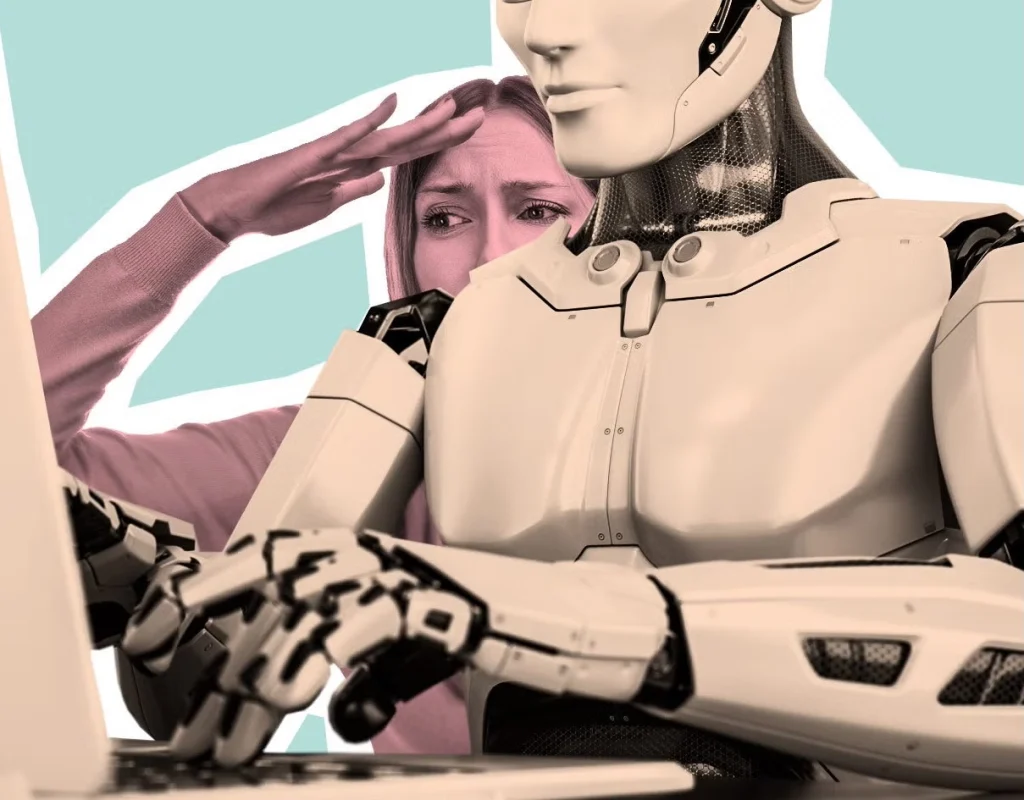
Human oversight. It sounds reassuring, doesn’t it? Like a steady hand resting on the wheel while machines hum in the background. Yet it’s often a mirage, or possibly an impressionist painting, that gets blurrier the closer you get.
At its core, oversight means awareness and authority: the ability of a person to watch, question, and, when needed, intervene. In a way, it’s almost paradoxical; we created AI to overcome the limits of human cognition, yet we now depend on those same imperfect minds to keep it in check. That seems like a bit of circular reasoning. The European Data Protection Supervisor (EDPS) and the EU AI Act make this explicit: meaningful oversight isn’t symbolic. It must reduce harm and preserve human rights. In high-risk systems, like those used in healthcare, legal issues, policing, insurance, or welfare decisions, it’s a matter of life, liberty, or livelihood.
But humans are fallible. We lean toward trust, especially when the machine speaks confidently. Psychologists call it automation bias: the reflex to believe the algorithm must be right, even when it clearly isn’t. How many people in companies believe a forecast on an Excel spreadsheet but never look underneath to see if the equations are correct? According to Forbes, 88% of spreadsheets have errors, yet everyone believes the numbers that are being presented. In 2025, a European Commission study put it bluntly: “human oversight” too often becomes ritual supervision, someone clicking “approve” because the system says so. Some of the key issues related to managing human oversight:
Legal systems: when algorithms arrest the wrong person
The legal world is particularly fragile here. It still relies on trust, procedures, and due process, concepts that don’t translate easily into Python code or LLM training.
In several U.S. cities, facial recognition tools were meant to “help” police identify suspects. Instead, they helped arrest the wrong people. At least eight Americans, most of them Black, were jailed after AI systems matched their faces incorrectly. Officers under pressure to close cases accepted the algorithm’s output as fact. One detective even wrote “100% match” in his report. The software vendor, meanwhile, had warned the match was nonscientific and required human corroboration. It’s the digital version of tunnel vision. Once the machine points a finger, the human eye follows.
A contrasting story comes from Colorado, where new policies require every facial recognition match to pass through a gauntlet of review: an analyst, a peer reviewer, and a supervisor must all agree before an arrest can even be considered. Crucially, the rule states that an AI “hit” can never count as probable cause. The law forces deliberation, it slows the machine down just enough for the human mind to catch up.
For mediators and arbitrators, the questions are almost forensic:
Was the AI result corroborated by independent evidence?
Were reviewers trained to question algorithmic certainty?
Did anyone exercise judgment, or simply affirm what the system said?
The answers reveal whether the oversight was genuine or performative.
Public administration: when bureaucracy forgets the people
If automation can err in a hospital or courtroom, imagine it running a welfare office.
Australia’s Robodebt program tried exactly that. Its goal was efficiency: use data-matching algorithms to spot welfare overpayments and issue recovery notices automatically. What could go wrong? Nearly everything. The system miscalculated debts, sometimes fabricating them altogether, and sent out hundreds of thousands of notices to citizens who had done nothing wrong.
When people protested, they encountered only digital walls, no human being empowered to fix the mistake. A Royal Commission later condemned it as a “failure of public administration” rooted in the absence of responsible human oversight. Some recipients took their own lives.
The pattern is eerily familiar. In Poland, a job-seeker algorithm categorized citizens into support tiers. Officials could, in theory, override the results, but they rarely did. Workloads were massive, training minimal, and management discouraged deviation. Humans became clerks to a machine that was supposed to serve them.
Oversight without agency is just obedience.
For neutrals assessing disputes with public algorithms, the signs of weak oversight are clear:
And yet, there are glimmers of success. New Zealand’s child-welfare system used AI to flag at-risk children but required caseworkers to personally review each alert. Their discretion improved outcomes, proving that AI plus empowered human judgment can outperform either alone.
Common cracks in the oversight facade
Oversight fails for many reasons, but they usually trace back to a few human truths.
People trust machines too much. They work too fast. They aren’t trained or encouraged to question authorities, especially when that authority is a digital worker. The EDPS notes that meaningful oversight requires both time and support; without those, even the best-intentioned humans become bystanders.
Interfaces matter too. Many AI systems hide their reasoning or bury the “override” button behind menus. A machine that never admits uncertainty trains humans to do the same. The result is what one researcher called “rubber-stamp oversight” fast, efficient, and catastrophically fragile.
The solution isn’t to slow everything down or ban automation. It’s designing friction where it counts: requiring double checks, showing confidence levels, forcing justification for acceptance. The system should occasionally reach out to humans and ask for feedback, rather than assuming compliance. As an example, in the NextLevel™ Mediation system, every AI output is first checked by the mediator/arbitrator/attorney before being shown or discussed with clients.
Organizations also need cultures that reward skepticism, not obedience. In one EU study, employees knowingly accepted biased AI recommendations when those outcomes aligned with company goals. Oversight in that context wasn’t broken, it was complicit.
Lessons for mediators and arbitrators in AI-related disputes
When an AI-related dispute reaches the mediation table, you aren’t just evaluating a technical glitch. You’re parsing a hierarchy of responsibility: between designer, deployer, and the human who clicked “approve.”
Ask simple questions that open complex truths:
These questions cut through the jargon and expose whether oversight was alive or asleep.
The emerging consensus, both in Europe and abroad, is clear: meaningful oversight is designed, resourced, and empowered. It requires humans who are literate in technology yet humble enough to question it, supported by institutions that value transparency over convenience and productivity.
Closing insights
In a sense, oversight is less about the machine and more about us. The algorithms are mirrors, flawless in reflecting our priorities and blind spots. When oversight fails, it’s not just a technical fault; it’s a moral one.
Legal systems collapse without human judgment. Healthcare loses its compassion. Bureaucracy forgets whom it serves. And yet, with the right checks, automation can amplify justice, safety, and fairness rather than erode them.
For those resolving disputes in this shifting landscape, the task is not to condemn or glorify technology, but to ensure it remains accountable to the same principle that has always underpinned law and medicine alike: the human must have the last word.
References

In light of the current COVID-19 crisis and adjustments that educators, universities, colleges, and employees are making to work and learning, I’ve posted resources that might useful to students, professionals,...
By David SmithNeuroscience and Conflict Resolution Blog by Stephanie West AllenIf someone were to take video tapes (with no audio) of your mediations, how different would one look from the other? We...
By Stephanie West AllenFrom the Real Divorce Mediation Blog of Nancy Hudgins and Debra Synovec Last weekend approximately 250 mediators, arbitrators, lawyers and conflict resolution professionals gathered at the 16th Annual Northwest Dispute...
By Debra Synovec, Nancy Hudgins