
Below is a provision that can be added to an Agreement to Mediate to preserve and extend mediation contractual confidentiality.
The parties and the mediator acknowledge that artificial intelligence (“AI”) tools may be used in connection with the mediation for administrative and/or substantive support purposes, including (by way of example) scheduling, document organization, note assistance, drafting support, issue identification, communication facilitation, or other mediation-related functions.
By signing this Agreement, the parties and the mediator agree that any such AI-assisted activity, and any information shared with or generated through such AI tools in connection with the mediation, shall be treated as mediation communications and shall remain confidential to the fullest extent permitted by applicable law, the mediation agreement, and any governing mediation confidentiality statutes or rules.
The parties further agree that the use of AI tools in connection with the mediation does not constitute a waiver of mediation confidentiality, privilege, or admissibility protections, and that any outputs generated through such tools are subject to the same confidentiality protections as other mediation communications.

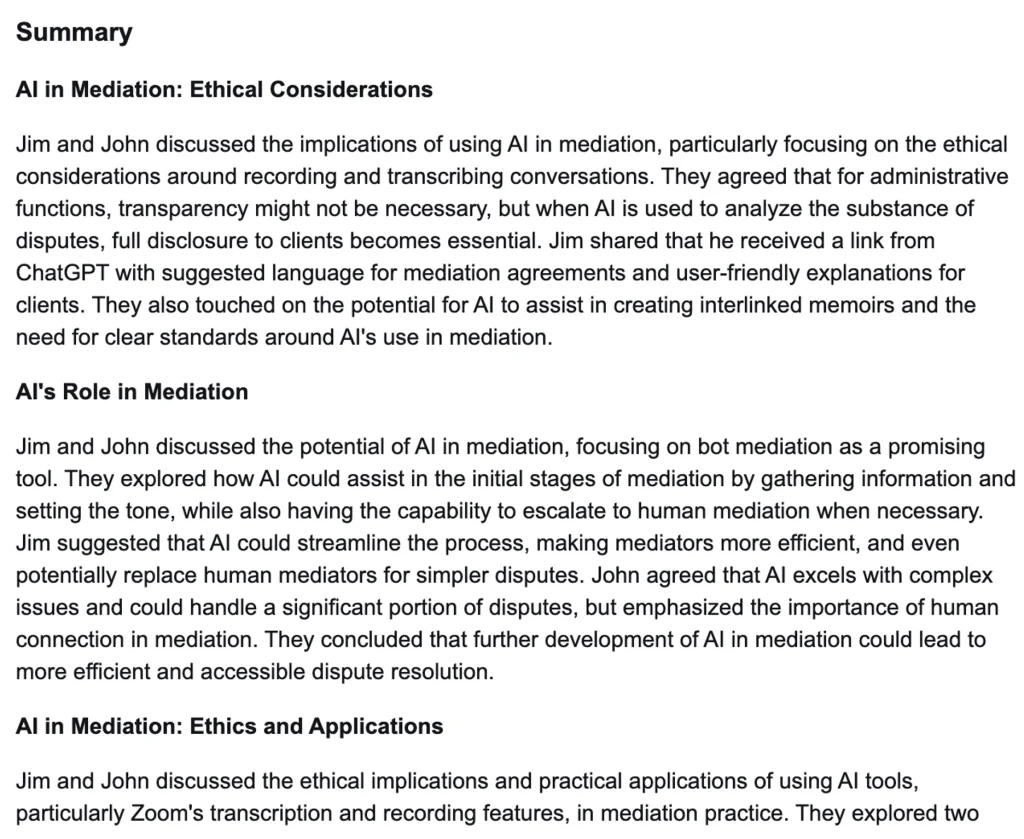
Use of Zoom, Recording, Transcript & AI Companion Features
Use of Zoom Platform and AI-Assisted Features.
The mediation may be conducted in whole or in part using the Zoom videoconferencing platform. The parties acknowledge and agree to the following:
Audio and Video Participation.
The mediation sessions may involve live audio and video communication through Zoom. No party may independently record the mediation without the express consent of all parties and the Mediator.
Recording, Transcripts, and Session Summaries.
With the knowledge and consent of the parties, the Mediator may utilize Zoom features, including Zoom’s AI Companion or similar tools, to create temporary audio and/or video recordings for the limited purposes of generating a written transcript, session summary, and/or action items to assist in the orderly conduct of the mediation. Such materials are intended solely as internal mediation aids and do not constitute a verbatim record, agreement, or official memorandum unless expressly designated as such by the Mediator and the parties.
Confidentiality and Limited Use.
Any recordings, transcripts, summaries, or action items generated through Zoom or its AI-assisted features shall be treated as confidential mediation communications and shall not be disclosed to any person or entity outside the mediation process, except as required by law or expressly agreed by all parties.
Data Retention and Deletion.
All Zoom recordings, transcripts, summaries, action items, and related AI-generated data associated with the mediation shall be permanently deleted by the Mediator within seventy-two (72) hours following their creation, and shall not be retained, reused, or incorporated into any other system or dataset.
No Substantive Evaluation by AI.
Zoom or any AI-assisted feature shall not be used to analyze, evaluate, or provide opinions regarding the merits of the dispute, the positions of the parties, or potential outcomes. The Mediator retains sole responsibility for all mediation judgments and interventions.

Although I am indisputably a "woman lawyer," I have never thought of myself in those terms. I'm a lawyer. And I'm a woman. I'm also a writer, a step-mother, a wife, a...
By Victoria PynchonThe decision to leave the EU has drawn the UK into the Nash Trap. U.S. mathematician John Nash (the movie The Beautiful Mind) postulated that Adam Smith’s declaration that ‘...
By Greg RooneyThis article is jointly written by a group of twelve institutional users of mediation services. Co-authors: Jan Eijsbouts, Hans Peter Frick, Bengt Gustafson, Marina Kaldina, Wolf von Kumberg, Michael Leathes,...
By Michael Leathes