For decades, the standard path for a mediator was to become a successful generalist. You hung a shingle, marketed your ability to facilitate dialogue, and took whatever came through the door—from personal injury to breach of contract.
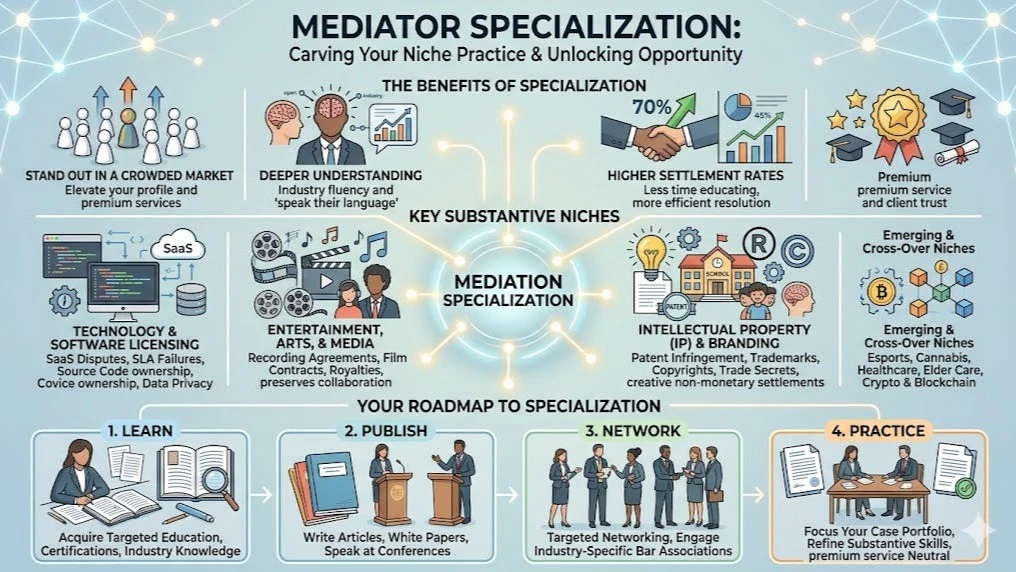
Today, the mediation landscape has shifted. As alternative dispute resolution (ADR) becomes deeply embedded in the legal system, parties and their counsel are no longer just looking for a good listener; they are actively seeking subject-matter experts. When millions of dollars, complex technical architectures, or a child’s future are on the line, parties want a mediator who already speaks their language.
Specializing in a substantive niche not only allows you to stand out in a crowded market, but it also increases your settlement rates. You spend less time learning the baseline facts of the industry and more time dismantling the actual barriers to resolution.
Here is a look at several highly substantive niches where specialized mediators are in high demand.
1. Technology and Software Licensing
The tech industry moves at breakneck speed, and litigation is often too slow and public for software disputes. Mediators in this space handle conflicts over Software as a Service (SaaS) agreements, Service Level Agreement (SLA) failures, source code ownership, and data privacy breaches.
- The Mediator’s Edge: You need a firm grasp of technical jargon, software development lifecycles, and modern licensing models (like open-source vs. proprietary). A mediator who understands the difference between a bug and a breach of warranty can quickly cut through the posturing and help parties find business-focused solutions, such as restructured licensing terms or extended service credits.
Selected Academic Resources & Industry Publications:
- Alyson Carrel, Mind the Gap: Bringing Technology to the Mediation Table, 2019 J. Disp. Resol. (2019), https://scholarship.law.missouri.edu/cgi/viewcontent.cgi?article=1836&context=jdr.
- John D. Feerick, Artificial Intelligence and Mediation Ethics, Touro L. Rev. (2024), https://digitalcommons.tourolaw.edu/cgi/viewcontent.cgi?article=2051&context=scholarlyworks.
- Resolving Technology Disputes: Mediation Strategies for a Fast-Moving Digital World, JAMS ADR Insights (2025), https://www.jamsadr.com/insight/2025/resolving-technology-disputes-mediation-strategies-for-a-fast-moving-digital-world.
- Robert J. Scott, Managing Software License Disputes: Cooperation or Litigation, Scott & Scott, LLP (2016), https://scottandscottllp.com/wp-content/uploads/2016/11/Managing-Software-License-Disputes.pdf.
- John Zeleznikow, Using Artificial Intelligence to Provide Intelligent Dispute Resolution Support, 30 Grp. Decis. Negot. 789 (2021), https://pmc.ncbi.nlm.nih.gov/articles/PMC8041614/.
2. Entertainment, Arts, and Media
Entertainment disputes are uniquely volatile because they blend highly complex contract law with intense personal egos and creative pride. This niche covers recording agreements, film and television production contracts, royalty accounting disputes, and talent management conflicts.
- The Mediator’s Edge: Success here requires high emotional intelligence paired with an encyclopedic knowledge of industry standards. Mediators must understand how royalties are calculated, how publishing rights are split, and how a “recoupable advance” works. Preserving the relationship is often critical here, as the parties may need to continue collaborating on a multi-record deal or a television series.
Selected Academic Resources & Industry Publications:
- Eric Strum, Profit Participation and Mediation, 18 Cardozo J. Conflict Resol. (2017), https://larc.cardozo.yu.edu/cjcr/vol18/iss2/8/.
- Mark Grabowski, Both Sides Win: Why Using Mediation Would Improve Pro Sports, 5 Harv. J. Sports & Ent. L. 189 (2014), https://journals.law.harvard.edu/jsel/wp-content/uploads/sites/78/2014/11/Grabowski.pdf.
- Behind the Scenes of Settlement: Advanced Mediation Strategies for Entertainment and Complex Business Disputes, American Arbitration Association (2026), https://www.adr.org/news-and-insights/mediation-mag-one-battle-after-another-until-mediation/.
- How Mediation Works in Entertainment Industry Disputes, American Arbitration Association (2025), https://www.adr.org/news-and-insights/mediation-in-entertainment/.
- Lights, Camera, Mediation: Why Public Figures in the Entertainment Industry Are Turning to ADR Processes to Resolve Their Disputes, Cardozo Journal of Conflict Resolution (2023), https://www.cardozojcr.com/cjcr-blog/lights-camera-mediation-why-public-figures-in-the-entertainment-industry-are-turning-to-adr-processes-to-resolve-their-disputes.
3. Intellectual Property (IP) and Branding
IP mediation covers a broad spectrum, including patent infringement, trademark dilution, copyright claims, and trade secret misappropriation. Because IP litigation is notoriously expensive and unpredictable, federal courts frequently mandate early mediation for these cases.
- The Mediator’s Edge: IP mediators often need specialized legal or technical backgrounds (especially for patents). In trademark and copyright disputes, a skilled mediator can guide parties toward creative, non-monetary settlements that a judge could never order—such as cross-licensing agreements, co-branding opportunities, or phased geographic phase-outs of a disputed mark.
Selected Academic Resources:
4. Special Education (IDEA)
Unlike commercial disputes, special education mediation is rooted in civil rights and administrative law, specifically the Individuals with Disabilities Education Act (IDEA). These mediations occur between school districts and the parents of children with disabilities, usually concerning Individualized Education Programs (IEPs) or 504 plans.
- The Mediator’s Edge: This is an incredibly high-emotion niche. The “asset” in dispute is a child’s developmental future. Mediators in this space must be deeply versed in state and federal education regulations. They must also possess the patience and empathy to balance the power dynamic between institutional school districts and fiercely protective, often overwhelmed parents—all while maintaining a focus on the child’s best interests.
Selected Academic Resources:
5. Emerging and Cross-Over Niches
Beyond the areas above, several other highly specific niches are rapidly growing:
- Esports and Gaming: Merging tech, entertainment, and employment law.
- Cannabis Business Disputes: Navigating the friction between state legality and federal prohibition in contract enforcement.
- Healthcare and Elder Care: Dealing with hospital billing, physician partnerships, and family disputes over aging parents.
6. Cryptocurrency, Blockchain, and Smart Contracts
The rise of digital assets and Web3 has created a novel frontier for dispute resolution. Traditional courts are often ill-equipped to handle the decentralized, pseudonymous, and cross-jurisdictional nature of blockchain disputes. Mediators in this space handle conflicts over cryptocurrency transactions, decentralized autonomous organization (DAO) governance, and flawed smart contracts. Smart contracts are self-executing agreements written in code, which automate performance but inherently suffer from incompleteness due to limits in human cognition and communication, leading to unpredictable disputes.
- The Mediator’s Edge: A mediator must understand the technical architecture of distributed ledgers, cryptographic proofs, and decentralized platforms. Resolving these disputes often involves blending traditional mediation techniques with blockchain-based online dispute resolution (ODR) systems that utilize game-theoretic incentives and crowdsourced decision-making. As smart contracts introduce new types of legal disputes, contracting parties are continually seeking the most effective institutional governance mechanisms to minimize dispute-resolution costs.
Selected Academic Resources:
- Darcy W. E. Allen, Aaron M. Lane & Marta Poblet, The Governance of Blockchain Dispute Resolution, SSRN Elec. J. (2019), https://doi.org/10.2139/ssrn.3334674.
- Luis Bergolla, Khaled Seif & Cansu Eken, Kleros: A Socio-Legal Case Study Of Decentralized Justice & Blockchain Arbitration, SSRN Elec. J. (2021), https://doi.org/10.2139/ssrn.3918485.
- Bronwyn E. Howell & Pieter H. Potgieter, Uncertainty and Dispute Resolution for Blockchain and Smart Contract Institutions, 17 J. Inst. Econ. 545 (2021), https://doi.org/10.1017/s1744137421000138.
How to Build Your Niche Practice
Transitioning from a generalist to a niche mediator does not happen overnight. It requires strategic positioning:
- Acquire Targeted Education: If you want to mediate software disputes, take courses in tech law or coding. If you want to do special education, attend IEP training seminars.
- Publish and Speak: Write articles (like this one) tailored specifically to the bar associations and industry groups of your chosen niche.
- Network with the Right Counsel: Stop marketing to “all lawyers.” If you choose entertainment, focus entirely on attending entertainment law mixers, film festivals, and music industry conferences.
By narrowing your focus, you aren’t limiting your practice—you are elevating it. When you become the go-to mediator for a specific industry, your practice transforms from a commodity into a premium service.
Summary: The Specialist’s Advantage
The era of the “one-size-fits-all” mediator is giving way to a demand for deep, substantive expertise. As dispute resolution becomes more sophisticated, parties are seeking neutrals who already understand the nuances of their specific world.
To recap the substantive niches shaping the future of mediation:
- Technology & Software Licensing: Requires fluency in tech jargon and agile development to save fast-moving tech companies from sluggish public litigation.
- Entertainment, Arts, and Media: Demands high emotional intelligence to navigate volatile clashes between creative egos, complex royalty structures, and preserving long-term collaborative relationships.
- Intellectual Property & Branding: Focuses on crafting creative, non-monetary solutions—like cross-licensing or co-branding—that traditional courts cannot order.
- Special Education (IDEA): A high-stakes, deeply emotional civil rights niche that requires balancing the institutional power of school districts with the fierce advocacy of parents.
- Emerging Niches (Cannabis, Esports, Elder Care): Rapidly growing sectors where the law is often still catching up to the reality of the business or family dynamics.
- Cryptocurrency & Blockchain: The newest frontier, requiring mediators to bridge the gap between traditional ADR and decentralized, code-based smart contracts and Web3 governance.
Conclusion: Stepping Into Your Niche
Transitioning from a generalist practice to a specialized niche is not simply a marketing tactic; it is a fundamental upgrade in the quality of dispute resolution you provide. When you deeply understand the mechanics of a specific industry—whether it is the emotional weight of an IEP meeting, the technical architecture of a blockchain ledger, or the financial intricacies of a film production contract—you stop spending valuable mediation time learning the baseline facts. Instead, you get straight to the vital work of dismantling the actual barriers to settlement.
Choosing a substantive focus requires an initial investment in targeted education and strategic networking, but the return on that investment is profound. By narrowing your focus, you transition from being viewed as a commodity to being recognized as an indispensable, highly sought-after industry expert.
The disputes of tomorrow are increasingly complex. The mediators who successfully resolve them must be, too. Find the industry that fascinates you, learn its language, and carve out your space at the table.
© 2026 N. Edward Timken. If you found these insights helpful and wish to reference them in your own posts, please provide a tag and attribution.

N. Edward (Ed) Timken
After a 30-year career as a court attorney for the New York State Court System, Nelson Timken has dedicated his practice to resolving disputes without the stress of litigation. Now operating in both New York and Florida, Nelson provides expert mediation and arbitration services in areas ranging from complex business… MORE