I first met Jim Melamed at the North American Conference on Peacemaking and Conflict Resolution in Montreal in March 1988.
It was my first conference.
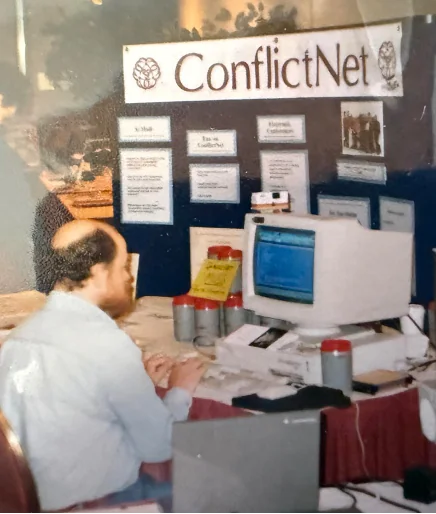
Like many first efforts, it was not a grand entrance. I had been placed in a small room, tucked away from the main flow of the conference—a kind of peripheral space where foot traffic was light and attention even lighter. I had set up a modest display: a computer, a demonstration of ConflictNet, and a hopeful expectation that someone might stop long enough to be curious.
For a while, not much happened.
And then Jim walked in.
He sat down at the table, looked at the computer, and began asking questions. There was nothing dramatic in the moment—no announcement, no sense of occasion—but as I showed him what I was building, something clicked for him.
Jim had just recently become the executive director of the Academy of Family Mediators, a growing organization in an emerging field. Like many organizations at the time, his board was geographically dispersed, and communication was slow, fragmented, and often frustrating—mailings, missed calls, endless rounds of phone tag.
As he watched the system, he realized—almost immediately—that this could change how he worked.
This was not just an interesting tool. It was a practical solution.
I could see the shift in his thinking as it happened. For me, the network was still something exploratory, full of possibility but not yet fully defined. For Jim, its application was instantly clear. He saw how it could be used—how it could solve a real problem, right now.
That moment marked the beginning of our collaboration.
Looking back, there is a certain symmetry in it. I had come to my first conference, tucked away in an overlooked corner, introducing something that very few people yet understood. Jim, already established in the field, found his way into that corner—and saw, perhaps more quickly than I did, what it could become.
In the early years that followed, that sense of being on the margins persisted.
As we began attending conferences together—eventually through the development of Mediate.com—we were often assigned similar spaces: small booths, out-of-the-way locations, areas with little natural traffic. We did what we could to draw people in, but for a time, we remained peripheral to the main current of the field.
But something gradual began to happen.
People would stop. Conversations would start. A small group would gather, then linger. What began as a demonstration would turn into a discussion, and the discussion would draw others. Over time, our booth became less a display and more a meeting place.
We also enjoyed handing out colorful reflective “I’m on ConflictNet” stickers at conferences so that our network members could identify one another and help promote the network. At a time when it was hard to find someone to engage in an email relationship, we helped people identify our shared ConflictNet email connection. People came to the booth for stickers, which became conversation starters at the physical conferences. Rather remarkably, our reflective stickers brought the ConflictNet online community together.
It was not something that we engineered so much as something that naturally emerged.
By the time the Internet had moved further into the mainstream—and as mediation itself continued to grow—the dynamic had shifted entirely. People began to seek us out. Our booth became a place where conversations were already happening, where ideas were exchanged, where the energy of the conference seemed, at times, to concentrate.
And then something even more telling occurred.
Other organizations began to notice.
If they wanted more traffic, more engagement, more visibility—they wanted to be near us. Booth placement, once an afterthought for us, became something others competed over. Proximity to our space meant proximity to the conversations that were drawing people in.

There was a quiet irony in that.
We had started in the margins—almost literally in a side room—and over time, without quite intending to, we had helped to create a new center.
For more information
about the founding of ConflictNet & Mediate.com
click here and here
Here is Jonathan Rodrigues’ recent interview of John and Jim

While professional ethics for attorneys are required subjects in law schools, ethics for mediators receive much less attention. In most Michigan law schools, the Michigan Mediator Standards of Conduct1 (hereinafter...
By Antoinette RaheemIn a recent experiment, Swiss Neuroscientists Beate Ditzen, Marcel Schaer, Barbara Gabriel, Guy Bodenmann, Ulrike Ehlert, and Markus Heinrichs found for the first time a direct connection between oxytocin and...
By Kenneth ClokeFrom the Real Divorce Mediation Blog of Nancy Hudgins and Debra Synovec Do you want to control your future or leave it to chance? Saving money is the catalyst for...
By Debra Synovec, Nancy Hudgins