
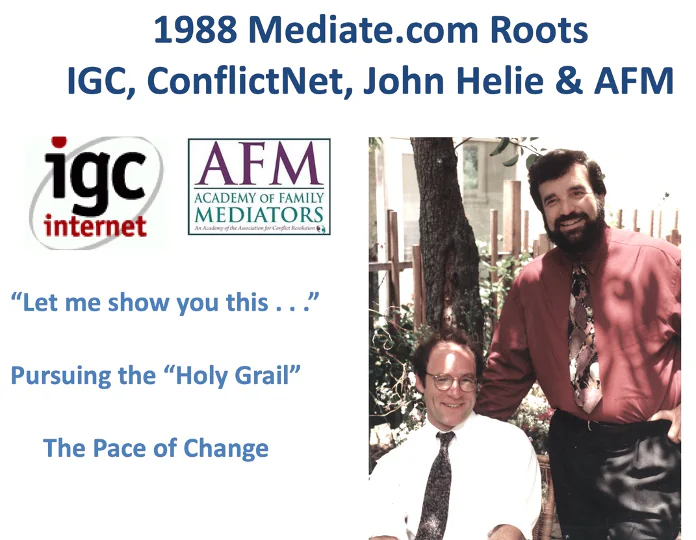
The earliest seeds of what would become Mediate.com were planted in March 1988 in Montreal. I had been hired the previous summer as the new Executive Director of the national Academy of Family Mediators (AFM) and was attending the North American Conference on Peacemaking and Conflict Resolution (NCPCR) as the AFM representative.
I loved the challenge and mission of my role at AFM, but staying in touch with Board Members was maddeningly inefficient. Everyone was busy. Reaching people by phone was hit-or-miss, and even when a connection was made, it only allowed for a two-person conversation. Beyond one monthly Executive Committee conference call and two in-person meetings per year, there were no reliable communication structures for the broader AFM Board.
As will become clear throughout this book, soccer—and, more precisely, lessons and relationships born from soccer—has been an unexpected through-line in my life. That pattern continued in Montreal. At the NCPCR conference, I was approached by Diana Gould, whom I had coached years earlier on the Katherine Branson–Mt. Tamalpais High School women’s soccer team. Diana told me she was now working with the Berkeley Community Dispute Resolution Center on a project called ConflictNet. She introduced me to her colleague and ConflictNet co-founder, John Helie, who was demonstrating the ConflictNet system at the NCPCR conference.
To understand the significance of what John showed me, it helps to remember the technological context of 1988. This was eight years before the graphical “.com” Internet and 7 years before Mediate.com. Communication was driven by slow modems onto green monochrome screens. Networks like CompuServe, Prodigy, and, eventually, AOL existed, but there was no open Internet. If you wanted to communicate electronically, you had to belong to a specific online network, and you could only interact with others on that same network.
ConflictNet was part of the Institute for Global Communications (IGC), a constellation of six progressive networks—PeaceNet, WomensNet, LaborNet, EcoNet, AntiRacismNet, and ConflictNet—funded by the Tides Foundation and headquartered in San Francisco’s Presidio. The system offered email, attachments, and discussion forums (then called “bulletin boards”). It was, for its time, astonishing.

The original ConflictNet (and Mediate.com) Logo
I vividly remember John demonstrating ConflictNet on a 900-baud modem. He showed how any member could email any other member—or an entire group—with a single command. Recipients could reply directly, reply to all, or choose a custom subset. Files could be attached. And the bulletin boards offered shared spaces where ongoing discussions, resources, and organizational history could live.
The power of this was immediate and electrifying. AFM would eventually create three bulletin boards:
These forums became invaluable—especially for “new joiners,” who could instantly access conversations, policies, and institutional memory that previously required years of phone calls and serendipity.
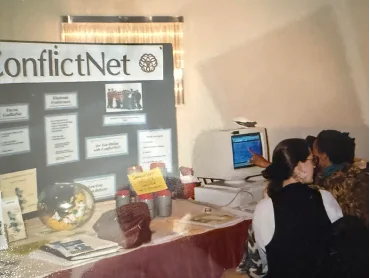
Promoting ConflictNet in the early days
I was so taken with the potential that—without prior board approval—I ordered 13 modems and 13 ConflictNet accounts for myself and all 12 AFM Board Members. At the next Board retreat, I arrived with a box full of hardware and gave a quick tutorial.
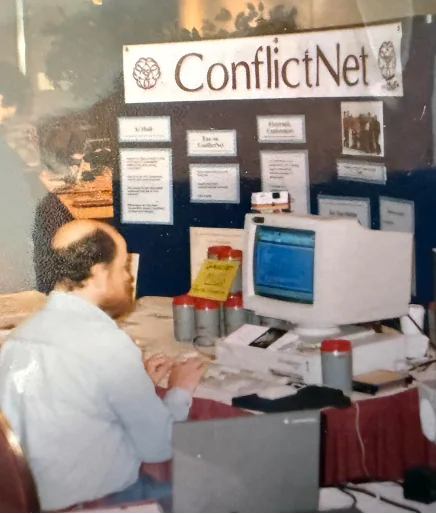
Checking out ConflictNet
To appreciate what happened next, it helps to know something about AFM. The Board did not operate by majority votes but by consensus. The aspiration was unanimity, and even when unanimity wasn’t possible, the culture still valued respect, deliberation, and deep listening.
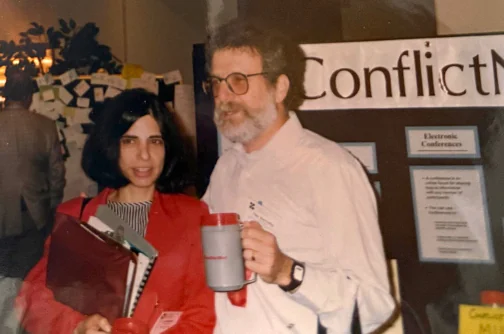
Early ConflictNet Members Linda Baron & Paul Wahrhaftig
Among the Board, however, was one member—now and always a dear friend—who had developed a bit of a reputation as a provocateur. This person opposed AFM joining ConflictNet. His or her concern, expressed with real passion and sincerity, was that online text-based communication would strip away “the humanity of our interactions”—the tone, the emotion, the nuance. He or she worried that our exchanges would become cold, robotic, and disconnected. Despite these concerns, ConflictNet was rather swiftly approved 11-1.
Overnight, everything changed for me. My phone stopped ringing. My stack of pink phone message slips disappeared. My work shifted almost entirely online—and was now rather suddenly quiet!
As a quick epilogue: the once-skeptical Board member both remains one of my closest friends, and, like the rest of us, is now fully dependent upon the Internet for nearly everything he or she does professionally.

John Helie – Visionary Extraordinaire
In sum, the Montreal NCPCR experience with John Helie marked a turning point in my life. It launched both me and AFM into the digital age, planted the conceptual seeds for Mediate.com, and demonstrated the power of technology to transform mediator and mediation communications.
To check out Jonathan Rodrigues’ recent
interview of John and Jim,
click here

The purpose of an apology is not to justify yourself. It is not what you want to say. It is about what the listener needs to hear. The weaponized apology...
By Malcolm McGuire, John PotterAt the beginning of a new year, it seems a good time to look back on some of the common excuses, sorry, reasons, for refusing to mediate that occasionally continue...
By Colm BranniganDisputing Blog by Karl Bayer, Victoria VanBuren, Beth Graham, and Holly Hayes Texas’ Fifth District Court of Appeals in Dallas has affirmed a lower court’s decision stating an agreement to...
By Beth Graham