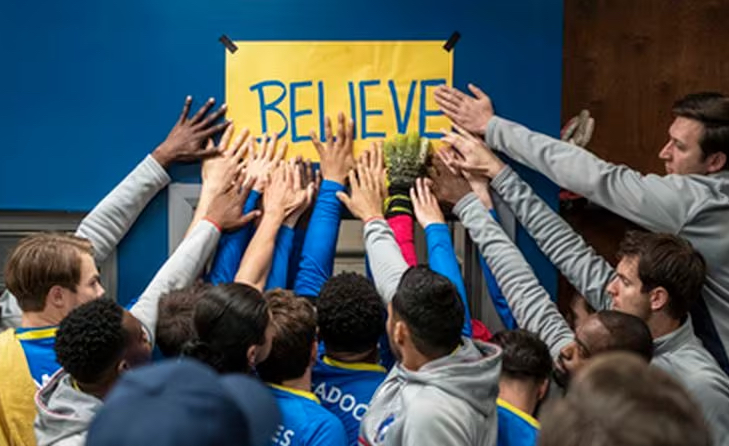
I heard about Ted Lasso, the TV series, from many of my friends, who said it was wonderful and well-worth watching. The idea of a TV series based on a sport (soccer) did not grab me, so I did not pursue my friends’ recommendations.
My brother suggested that I purchase the Apple Mini Home Pod, a powerful small speaker, to enhance by iPad experience. Since he’s my big brother, and since I (usually) trust his recommendations, I purchased it. And when I did, I discovered that it came with three months of free Apple TV. So I decided to give Ted Lasso a try. (It had the bonus of providing another binge-worthy series, “Bad Sisters,” also recommended by my brother, which I loved. Do genes say something about tastes in TV shows?)
To put it mildly, I was bowled over by the Ted Lasso series. I watched (actually binge watched) all three seasons, and then eventually, watched the first season again, this time taking notes. The show, written by two of the leads, Jason Sudeikis and Brett Goldstein, among others, is a wonderful combination of “The Office”, “Forrest Gump” and “Mister Rogers.” And I learned a lot about soccer along the way.
In every episode, really almost every few minutes, there is a message that rings true about life, work relationships, friendship, and people in general. One can use the wisdom of Ted Lasso as a template for living, and it certainly has many lessons that resonate with me in my work as a lawyer and mediator. (Spoiler alert — it’s not really about soccer.)
Here are just a few lessons that mediators can learn from Ted Lasso. (More to come in future posts.)
People are not what they seem to be at first. Everyone has their own personal story. All people (except villains, such the character, Rupert Mannion in Ted Lasso) strive for goodness. Leslie Higgins turns out not to be an effete toady. Trent Crimm turns out to be a sweet helpful and sensitive person, and not a rabid tabloid journalist trying to “get” his victim. Yet, Ted Lasso is what he seems, from the very beginning – a spiritual being sent to the miasma of the struggles of the world – in this case soccer team in turmoil. It’s a mess, affected by all sorts of interpersonal and external forces (including the owner’s post-divorce trauma). Ted Lasso is like an angel – no, maybe he is an angel. The series is about how a completely positive spirit can bring peace in peoples’ lives. That’s what we as mediators should (and can) strive for.
Always treat people with respect. In Episode 1, Ted asks Nathan what his name is. Nathan’s job as a “kit man” is considered the lowliest work function on the soccer team. He thinks of himself is basically a nonentity, and is harshly bullied by the team. When Ted walks away after learning Nathan’s name, he says, “I love this kid.” Ted always makes everyone a better person. He motivates people through his positivity, and empathetic perspective. The next time he sees Nathan, when Nathan gives Ted a sports drink, Ted says to him, “You continue to impress, Nathan,” and Nathan murmurs, “You remembered my name!” Remembering someone’s name in an expansive sense means remembering who they are. In Episode 2, Rebecca Welton, the team’s owner, says of Ted Lasso, “The man’s just relentless – and nice!” Yes, he is relentless in his love of people, in spite of their imperfections and foibles. Kindness exudes from him, and yet his character is believable. As mediators we care about our clients and try to make each of them feel good and respected. It also demonstrates how our first conclusion about who are clients really are may be dead wrong.
Seek to maintain a positive outlook. In Episode 2, Rebecca asks Ted how his first day went. He responds by asking her what the smallest unit of measurement is. She says, “And yet, you seem undeterred.” Once again, Ted shows how a person with a good outlook on life and a strong sense of self combined with a measure of humility can function in the world when facing a setback. Don’t let the setbacks in mediation disturb or derail your efforts and positive outlook. Be like Ted Lasso.
Don’t get into arguments. Ted puts a suggestion box in the team’s locker room to get some ideas for helping the team. Roy says “We’re in the middle and we’velost 3 out of 4. And you want to know if the snacks in the vending machine are tasty enough?” Ted responds (innocently), “Are they?” A perfect response. He did not try to counter Roy’s comment, but with handled it with a sense of humor. No one ever “wins” an argument. Pursuing arguments is a lose-lose situation.
That’s all for now, and this is just from watching the first two episodes of Season One. I’m looking forward to sharing Ted Lasso’s wisdom in future posts.
Laurie Israel is an attorney, consultant, and mediator, concentrating her practice on both prenuptial and postnuptial agreements. She works as a consultant and mediator nationwide. She previously practiced for 35 years in the areas of tax law, divorce, collaborative law, estate planning, probate of estates and trust administration, as well… MORE >
1. Steadfast adherence to a strict moral or ethical code. 2. The state of being unimpaired; soundness. 3. The quality or condition of being whole or undivided; completeness. ETYMOLOGY: Middle...
Conflict Remedy Blog by Lorraine Segal How can we heal the deep divisions in our country? How do we talk to each other with compassion and empathy across our differences?...
From the Mediation Matters Blog of Steve Mehta.On many playgrounds, you will often hear the phrase “that’s not fair.” Those three words also have a huge impact in dispute resolution. ...
To provide the best experiences, we use technologies like cookies to store and/or access device information. Consenting to these technologies will allow us to process data such as browsing behavior or unique IDs on this site. Not consenting or withdrawing consent, may adversely affect certain features and functions.
Functional
Always active
The technical storage or access is strictly necessary for the legitimate purpose of enabling the use of a specific service explicitly requested by the subscriber or user, or for the sole purpose of carrying out the transmission of a communication over an electronic communications network.
Preferences
The technical storage or access is necessary for the legitimate purpose of storing preferences that are not requested by the subscriber or user.
Statistics
The technical storage or access that is used exclusively for statistical purposes.The technical storage or access that is used exclusively for anonymous statistical purposes. Without a subpoena, voluntary compliance on the part of your Internet Service Provider, or additional records from a third party, information stored or retrieved for this purpose alone cannot usually be used to identify you.
Marketing
The technical storage or access is required to create user profiles to send advertising, or to track the user on a website or across several websites for similar marketing purposes.