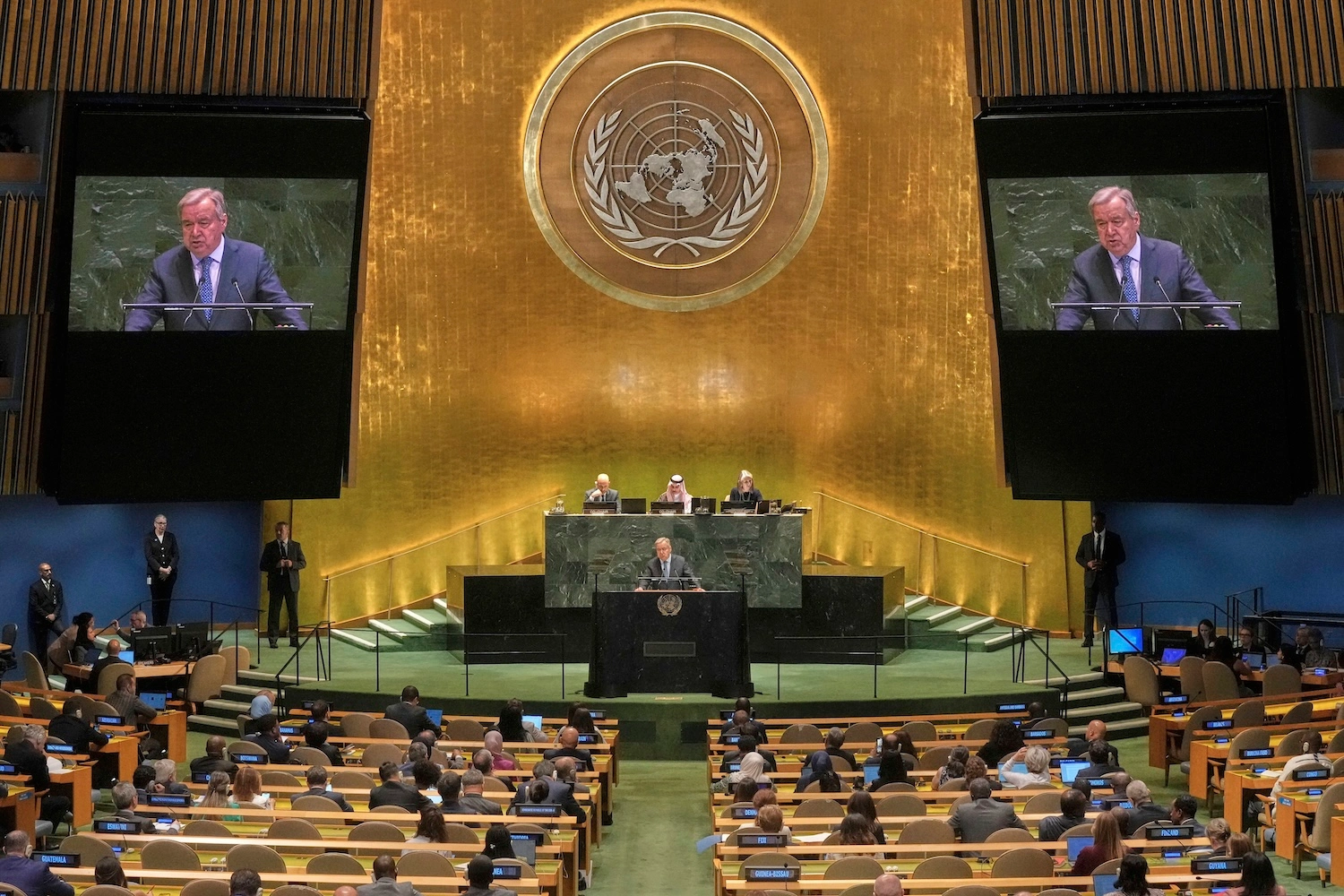
For 12 grueling hours in late April, and six further hours last week, the six candidates competing to become the next United Nations secretary-general were grilled by U.N. member States and civil society in open interactive dialogues. As each candidate sat for three hours answering questions during these marathon sessions, it was clear that a collective groupthink has engulfed the U.N.: that the institution is missing in action when it comes to peace and security, and the answer to reversing this trajectory is for the next secretary-general to first and foremost be a mediator-in-chief. But as these candidates jostled to present platforms promising a new mediation crisis-response posture for the U.N., the word “peacebuilding” was barely uttered once.
Nostalgia for the type of leadership seen by previous secretary-generals such as U Thant in the 1960s, which has been documented in a recent book that seems to have been read by every U.N. ambassador in New York, has led to many yearning for a return to a frontline leader who can effectively mediate between warring parties to avoid all-out conflict. While candidates all sought to demonstrate their commitment to this idea that bold action and principled peacemaking were necessary ideals of the next secretary-general, peacebuilding — or efforts to address the drivers of conflict — was notably absent from discussions. This is despite the latest Global Peace Index from the Institute of Economics and Peace recording violent conflict levels at their highest in more than two decades.
As the U.N. convenes this week to host its first-ever Peacebuilding Week, a timely question must be raised: does the emerging narrative in the secretary-general search risk pushing the U.N. towards a posture that prioritizes crisis response, elite bargains, and shuttle diplomacy, at the expense of peacebuilding efforts that require longer-term investment to address the structural, political, economic, and social — including gender-related — drivers of violent conflict?
At a moment when trust in multilateral institutions has been eroded by continued failures to prevent or respond effectively to crises in Gaza, Sudan, Ukraine, Myanmar, Iran, and Lebanon, a new leader undoubtedly must strengthen the U.N.’s mediation and crisis-diplomacy capacity. But to deliver on the world’s “most impossible job,” as the U.N.’s first secretary-general, Trygve Lie of Norway, described it to his successor, Sweden’s Dag Hammarskjöld, this investment in crisis response will only reap dividends if peacebuilding remains a strong part of what the U.N. can offer
The U.N. secretary-general is charged with upholding the values and moral authority of the United Nations and using the role as the world’s chief diplomat to attempt to prevent international disputes from arising, escalating, or spreading. Elected by the U.N. General Assembly at the recommendation of the 15 members of the U.N. Security Council, potential candidates know that the real power ultimately resides in the five permanent members of the Security Council — China, France, Russia, the United States, and the United Kingdom — each of whom holds veto power over the appointment.
Last week’s dialogues allowed the six public candidates in the race to replace current U.N. Secretary-General Antonio Guterres — Rafael Grossi, Michele Bachelet, Macky Sall, Rebeca Grynspan, Maria Fernanda Espinosa, and Carolyn Rodrigues Birkett — to present their vision to the U.N. General Assembly.
Starting in late July, the Security Council will embark on a closed voting process known as “straw polls” to assess the viability of each candidate. These votes usually conclude in September or October, once the Council coalesces around one candidate, who then will be nominated to the U.N. General Assembly to serve as the 10th U.N. secretary-general, taking office on Jan. 1, 2027.
The next secretary-general will assume the role in a fragmented global order, a world that is quite different from the one that Guterres inherited 10 years ago. At the time, the U.N. was fresh off the success of agreement on a new U.N. Sustainable Development Agenda, coupled with high-profile convenings like the World Humanitarian Summit, and multilateralism appeared to be in a healthy place. Buoyed by successful multilateral efforts to resolve the Gambian crisis in early 2017, Guterres set out to deliver a big early win by trying to lead peace talks to solve the frozen conflict in Cyprus. But the collapse of these efforts in 2017 was a sign of what was to come for the U.N. secretary-general. This setback, together with failing implementation of the Sustainable Development Goals, and crumbling support for U.N. peacekeeping, began to put serious pressure on U.N. leadership.
Yet, the narrative about Guterres’ failure as a high-level peacemaker has been most reinforced by the inability of U.N. leadership to tackle the major crises of the day. Failure to prevent or end the invasion of Ukraine by Russian forces, lack of action to mitigate the devastating civil war in Sudan — resulting in the world’s worst humanitarian crisis — and the brutal assault by Israeli forces on Gazan civilians laid bare the stark shortcomings of the current U.N. system in the realm of peace and security. The U.N. secretary-general is, of course, not to blame for any of these wars, to be sure — the dysfunctional and increasingly politicized permanent five members of the Security Council must take the bulk of the blame — but there has been no notable success attributed to his leadership in relation to preventing violent conflict or negotiating a cease-fire.
While the inability of the U.N.’s executive leadership to effectively respond to major crises certainly deserves serious interrogation, the current rhetoric could encourage the next secretary-general to overcorrect the focus of the U.N. peace and security architecture. An all-in approach on mediation and crisis response might risk throwing the baby out with the bathwater and losing some of the positive strides made on peacebuilding.
For all the negative sentiment regarding Guterres’ tenure on high-profile peace and security issues, his efforts to strengthen the U.N.’s peacebuilding work should not be overlooked. One of the first reforms was the renaming of the Department of Political Affairs into the Department of Political and Peacebuilding Affairs in 2017, uplifting peacebuilding rhetorically within the U.N. system. This shift, together with calls for a “quantum leap” in funding for peacebuilding, championing a New Agenda for Peace, and advocacy to then help secure assessed contributions for the U.N. Peacebuilding Fund, represented significant political and resource investment in U.N. peacebuilding. These positive developments — viewed in parallel with the rise of hard-security agendas at the U.N. such as counterterrorism — are welcome, even though much more progress is needed to ensure that far more resources and power shift to peacebuilders on the ground rather than being absorbed by U.N. agencies or programs.
Unfortunately, several factors in the past 18 months have derailed some — perhaps much — of the momentum that had been generated for peacebuilding. The arrival of the second Trump administration in January 2025 was one, with its rhetorical and diplomatic assault on the U.N., its withdrawal from some U.N. organizations, and its withholding of funding. Another factor was the morphing of the UN80 process, intended for strategic reform, into a drastic budget-cutting exercise to address a financial crisis prompted by U.S. and other cuts. And a third element was the sidelining of comprehensive multilateral agreements like the Pact for the Future.
Still, the fact remains that peacebuilding continues to enjoy significant support at the U.N. The twin U.N. General Assembly and U.N. Security Council resolutions renewing the U.N. peacebuilding architecture were adopted unanimously in November 2025. The General Assembly’s main budgetary committee still agreed to provide funds to the U.N. Peacebuilding Fund. And this week, the U.N. community meets for the first U.N. Peacebuilding Week. U.S. withdrawal from the U.N. Peacebuilding Commission aside, there are still plenty of opportunities that new U.N. leadership could seize.
Given the current emphasis by some of the most powerful global leaders on foreign policies founded on ideals akin to “peace through strength,” peacebuilding might not be perceived as a vote winner this July for those vying to replace U.N. Secretary-General Guterres. But there is clear evidence that peacebuilding works when done correctly, that it is a smart investment, and that communities around the world want and need it.
So the candidates for secretary-general would be smart to start thinking about how they can champion — and reform — the U.N.’s peacebuilding work to complement a reinvigoration of the crisis prevention and response capacity. Strong starting points could include finding further ways to promote national ownership of peacebuilding, getting serious about peacebuilding support that protects human rights and promotes civic activity in countries most affected by violent conflict, and prioritizing investment in peacebuilding that is locally led and focused on community and civil society strengths and leadership.
Certainly, there are choppy waters ahead for the peacebuilding agenda as a whole. Major donors to the Organization for Economic Co-Operation and Development (OECD), including Germany, the U.K., France, the Netherlands, and Sweden, are dramatically reducing overseas development assistance budgets, while simultaneously investing huge sums in military and defense spending. New leadership at the U.N. should do what it can to resist this larger move towards what Executive Director Chris Coulter of the Berlin-based Berghof Foundation has labelled “defunding peace and calling it security.” This should start by maintaining strong rhetorical support for both increased investment and necessary reform in global peacebuilding efforts.
While we hope the next secretary-general will be an effective mediator, the selection cannot rest solely on the candidate’s ability to shuttle between crises. An equal task will be whether they can protect, reform, and champion U.N. peacebuilding to ensure that the U.N. and partners increase resources for that work and that those resources are more accessible and flexible for civil society — particularly women and youth-led organizations — to lead initiatives from the grassroots. At a moment when violent conflict is at its highest level in decades and aid cuts are eroding support for long-term peacebuilding efforts around the world, peacebuilding cannot become an afterthought.
Read the complete article here.
Carrie Menkel-Meadow is an advocate for mediation and negotiation being a required course for children in schools and also as a part of every professional education.
By Carrie J. Menkel-MeadowHow to get parents on the same page - Even in the middle of divorce Divorce can be tough on everyone. Parents, children, families, attorneys, employers, and mediators. As two...
By Brandyn Roark Caires, Jen SchimbenoIn the middle of the journey of our life I came to myself within a dark wood where the straight way was lost. Dante Alighieri When the journey turns from litigation...
By Victoria Pynchon