In any situation in which you are uncertain, consider: “What do I want to come of this? What is this for?”
Helen Schucman
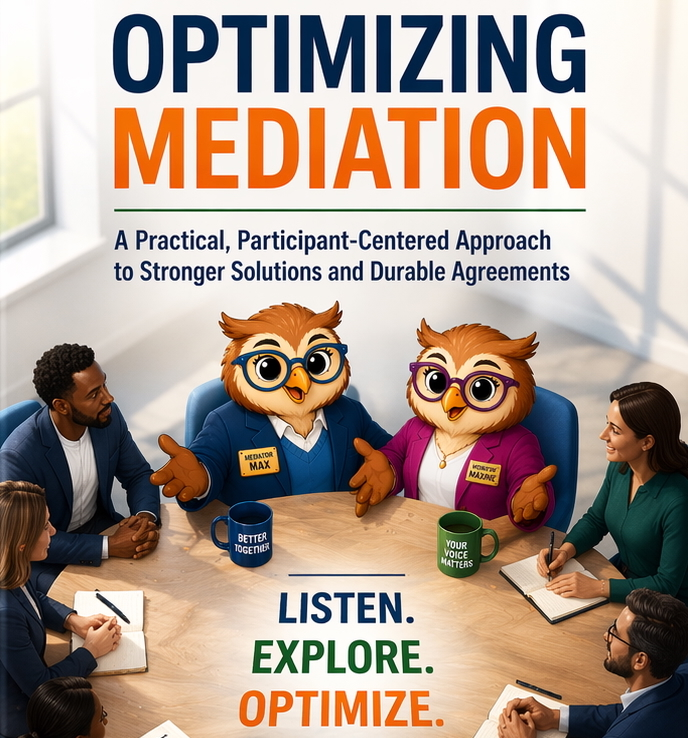
Mediation has long been the one dispute resolution process that genuinely offers participants the possibility of optimized outcomes. Litigation and arbitration revolve around persuading a decision-maker “who is right.” Their goal is not to optimize satisfaction for all involved—it is to prevail. Mediation stands alone in creating space where participants can explore solutions that maximize value for everyone. And this defining quality has now been dramatically amplified by the integration of AI into mediation practice.
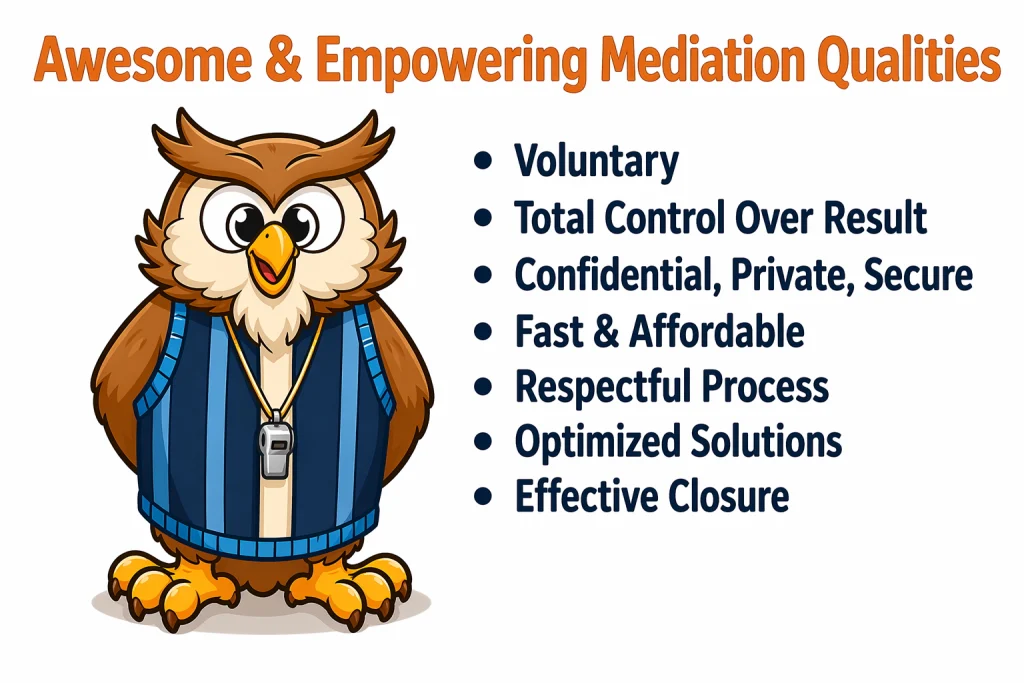
With its unique combination of facilitated dialogue, voluntary participation, confidentiality, and complete participant decision-making power, mediation provides a safe environment for early and informed exploration of settlement possibilities. Post-Covid, mediation has also become far more accessible and affordable: between 70% and 80% of mediations now take place fully online. Convenience, comfort, and capability have converged.
While mediators have always differed in their approaches to participant empowerment, AI is reshaping the landscape. Participants rarely arrive “at their best.” Mmore commonly, they arrive as their rehearsed “contentious worst.” The effective integration of AI, however, dramatically expands our ability—mediators and participants alike—to help everyone ultimately operate at their informed best.
AI is already an extraordinary idea generator for participants in mediation. Participants can, for example, now ask one or more AI systems to identify solutions that have worked for others in similar circumstances. Mediators can complement these inquiries by assisting participants in crafting thoughtful prompts that highlight positive intentions, future interests, concrete needs, goals, hopes and desired outcomes.
Intriguingly, questioning has always been a mediator’s primary tool for eliciting information and exploring optimizing possibilities. “Questioning”—the mediator’s craft—now seamlessly overlaps with “prompting” in AI platforms. Thanks to advances in natural language processing (the new “NLP”), we interface with AI the same way we interface with people: through carefully framed questions. In both mediation and AI, it is all about the questions you ask.
Importantly, our ability to integrate AI into mediation did not appear overnight. The field’s journey—from early digital networks such as ConflictNet, to Mediate.com’s decades of development—reflects nearly forty years of growing technological alignment. That history has paved the path to today’s remarkably capable online mediation tools and AI-enhanced processes.
One important question as we move forward is how the mediation field might best collaborate to build high-quality, practice-specific AI knowledge bases. The old maxim applies: “garbage in, garbage out.” Poorly curated data sets generate poor results. By contrast, optimized data sets yield optimized insights—for mediators and participants alike.
Supercharged by AI, mediation is the dispute resolution process most naturally designed for future optimization. Operating online and supported by high-quality, domain-specific AI systems, mediators can help produce optimized resolutions at scale—accessible to the general public, not just to those who can afford elite representation.
And still, this is only part of the opportunity.
It is time, I suggest, for the field to also consider adopting “optimization” as an aspirational ethical standard. Why strive for anything less? Mediation’s greatest promise may well be captured in the phrase: Mediation = Optimization.
Optimization is not foreign to mediation—it is embedded within it. Mediators intuitively seek to create as much substantive value as possible for every participant, knowing that higher experienced value produces more durable and satisfying agreements. We like it when participants smile!
Historically, mediators have shared “normative stories” about how similarly situated parties have resolved similar issues. Today, both mediators and participants routinely consult AI platforms for such potential solutions. This is not futuristic speculation; it is already everyday practice among mediators, disputants, and counsel.
Humanity is overdue to move beyond “battle mode” and beyond “barely sufficient solutions.” Mediation’s future lies in mediated optimization—helping people achieve their most capable decisions in the most humane, informed, and collaborative way possible. With AI, we now have powerful new tools to assist participants in fully considering their situation and identifying best-possible outcomes. This ability to incorporate all relevant information differentiates mediation from all other adversarial processes.
My hope is that we not only embrace optimization as a goal of mediation, but also—by reflection—help normalize optimized problem-solving as a societal and global aspiration.
Finally, as mediation continues to move online, I aim to share what I have found over forty years of practice to be effective approaches that translate well to digital environments. I will also highlight resources—at Mediate.com and elsewhere—to help us all move forward as capably as possible.

No one begins a dispute thinking they might be wrong. This sense of moral and legal certainty is usually coupled with high expectations. As a result, parties can arrive at...
By Bernard MorrowMediation before the mediation; The important role of a pre-mediation session. Marco Imperiale and Myer J. Sankary, Esq. Introduction Looking at the mediation articles published in journals and circulating online,...
By Myer J. Sankary, Marco ImperialeI receive certain questions regularly via email, so thought I’d post answers here to save some of you the time inquiring. If you have questions I haven’t addressed here, please...
By Tammy Lenski