Recently, I’ve been having more discussions on the core topic of self-worth: Am I a good or bad person? Am I valuable? Am I lovable? Do I deserve to be happy? And, most importantly, who chooses the answers to these profound questions: You or other people?

I find it useful to divide this inherent conflict about self-worth into two different aspects: (1) Whose criteria are used to judge your self-worth: yours or others? (2) Who’s the ultimate judge of your self-worth: you or others?
Naturally, we can resolve the conflict (as we often do), by using other people’s criteria (of what it means to be a good or bad person, etc.) and then allow them to judge us accordingly. Our feelings about ourselves are therefore determined by cultural norms and other people’s expectations. We can also resolve the conflict by ignoring our surrounding society and rely solely on our own criteria and be our own judge exclusively. As a result, a person can choose whatever criteria suit him or her and then render the final decision. Ironically, however, people often pick perfectionistic criteria for themselves and then judge themselves much more harshly than any other person or group would judge them!
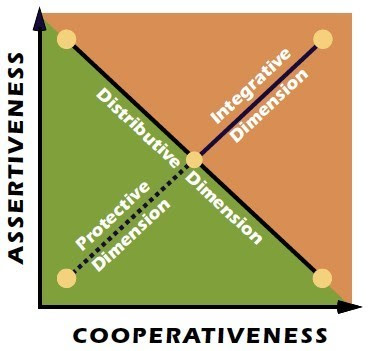
Using the TKI Conflict Model, we realize that the either/or choice of who determines your self-esteem (short term and long term) is on the distributive dimension. At best, we can come up with some compromise solution: For example, when I am with my family, I use my own criteria to judge my self-worth and I, myself, render that decision. But when I am at work, I rely on my boss, co-workers, and the reward system to determine how I feel about my self-worth: They render that decision for me, based on their criteria and their assessment of my competency and contribution.
Of course, if we can move this discussion from “either/or” to “both,” we can move up the integrative dimension on the TKI Conflict Model and find creative ways to synthesize our criteria, others’ criteria, my judgment, and others’ judgments…to arrive at our self-worth in a manner which recognizes that we are both an individual AND we are embedded in a society (where how we behave affects other people).
The nature of self-worth and self-esteem seems to always influence how people approach all their other conflicts in life. And yet, most often, the underlying — unresolved — conflict is usually who has decided, according to whose criteria, whether a person deserves to feel good about themself in the first place. Perhaps by resolving this more fundamental conflict in a more integrated way will then enable all our other conflicts in life (at home and at work) to be addressed much more directly — and effectively.
Kilmann Diagnostics offers a series of eleven recorded online courses and nine assessment tools on the four timeless topics: conflict management, change management, consciousness, and transformation. By taking these courses and passing the Final Exams, you can earn your Certification in Conflict and Change Management with the Thomas-Kilmann Instrument (TKI). For the most up-to-date and comprehensive discussion of Dr. Kilmann’s theories and methods, see his 2021 Legacy Book: Creating a Quantum Organization: The Whys & Hows of Implementing Eight Tracks for Long-term success.
Photo by Mohamed Nohassi on Unsplash

Copyright Deborah S. Laufer, May 2001 May be reproduced, only with attribution, by Federal, State, and all nonprofit organizations. Please contact author for other requests to reproduce or distribute. Table...
By Deborah LauferIntroducción: Nuestro siglo nos presenta permanentemente situaciones paradójicas. La Globalización puede lograr que los avatares económicos de Gambia tengan decidida influencia en Bolivia, pese a que crecen y se multiplican...
By Alberto ElisavetskyI'm writing this from the cockpit of our new sailboat, "Time Out" on Catalina Island. I can't help but reflect on how taking some "time out" to do some perspective...
By Jan Frankel Schau