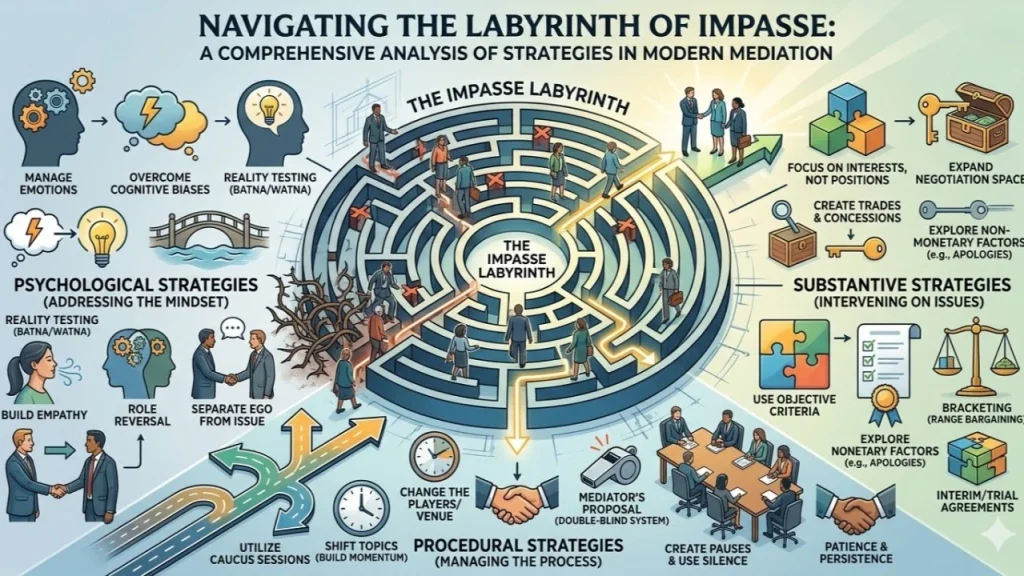
The phenomenon of impasse in mediation represents more than a mere cessation of dialogue; it is a critical juncture where the biological, cognitive, and social frameworks of the participants collide with the structural limitations of the dispute resolution process. While traditional views often characterize impasse as a failure or a dead end, contemporary conflict theory redefines it as a moment of profound significance that demands a pivot in methodology rather than an abandonment of the effort. At this intersection, the mediator must transition from a facilitator of conversation to a process architect capable of diagnosing the underlying pathologies of the stalemate and applying targeted interventions that address the emotional core, cognitive distortions, and strategic entrenchment of the parties involved.
The Etiology of Impasse: Psychological and Cognitive Foundations
To effectively address impasse, the mediator must first understand its multi-dimensional origins. Research indicates that many stalemates are rooted in the fundamental mismatch between the presented legal or monetary positions and the unspoken psychological needs of the disputants.
The Weight of Unmet Needs and the Preservation of Dignity
Often, impasse stems from a fundamental mismatch between the presented positions and the underlying, often unspoken, needs of the parties involved. A rigid demand for a specific monetary settlement might mask a need for recognition, apology, or a sense of control. This observation aligns with the professional consensus that a “fight over the decimal point is often a fight over dignity.” Mediators must develop a keen ear for these unspoken needs, probing beyond the stated demands to uncover the emotional core of the conflict (“Skills and Techniques used in Mediation,” Academia.edu, 2018, https://www.academia.edu/36638539/Skills_and_Techniques_used_in_Mediation). When a party feels that their core identity or sense of fairness has been violated, they may adopt a stance of “principled” inflexibility, where the utility of a settlement is outweighed by the psychological cost of perceived submission (Sam Imperati, “50 Ways to Break an Impasse: Tips, Tricks, Traps and Tools,” ODR Europe, 2015, https://www.odreurope.com/assets/site/content/50WaysToBreakImpasse.pdf).
The Trap of Cognitive Biases
Human cognition is beholden to systematic biases that obscure objectivity and hinder agreement. Understanding these biases—both the mediator’s own and those of the parties involved—is essential for moving past a deadlock. Several specific biases frequently trigger impasse:
Confirmation Bias: This involves seeking information that reinforces existing beliefs while ignoring contradictory evidence. Mediators counter this by using open-ended questions to force reflective and conscious thinking patterns (Rick Weiler, “Cognitive Strategies to Move Past Impasse and Achieve Settlements in Mediation,” ADR Services, 2021, https://www.adrforum.com/blog/post/Cognitive-Strategies-to-Move-Past-Impasse-and-Achieve-Settlements-in-Mediation).
Anchoring Bias: This leads parties to rely overly on the first piece of information offered, such as an initial demand. Mediators use brackets or ranges to re-anchor the bargaining zone (“Mediation plus: Don’t leave money on the table,” JD Supra, 2014, https://www.jdsupra.com/legalnews/mediation-impasse-busting-techniques-04011/).
Prospect Theory (GOLF): Under this theory, losses loom larger than gains, which leads to risk-seeking behavior in loss scenarios. Reframing settlement terms as “profits” or “gains” rather than “expenses” or “losses” can mitigate this (Claudia Winkler, “Negotiation Tricks for Successful Mediators: The Framing Effect,” New York Dispute Resolution Lawyer, Spring 2014, https://www.necademy.com/wp-content/uploads/2017/09/DisputeResolutionLawyerSpr14_Winkler.pdf).
Reactive Devaluation: This causes parties to dismiss proposals simply because they originate from an adversary. Delivering the same proposal as a neutral “Mediator’s Proposal” serves as a remedy (Patrick Jones, “The Mediator’s Proposal: A Useful Tool for Breaking Impasse,” Henning Mediation, 2025, https://www.henningmediation.com/blog/the-mediators-proposal-a-useful-tool-for-breaking-impasse/).
The Riskin Framework: Orientations, Strategies, and the Negotiation Within
Professor Leonard L. Riskin has profoundly influenced the field by providing a comprehensive vocabulary and structural model for understanding mediator behavior. His methodology focuses on how a mediator’s orientation determines the techniques used to address impasse.
The Riskin Grid: A Tool for the Perplexed
Riskin’s landmark contribution, the “Grid for the Perplexed,” classifies mediation into four quadrants based on two continuums: the Mediator’s Role (ranging from Evaluative to Facilitative) and Problem Definition (ranging from Narrow to Broad) (Leonard L. Riskin, “Understanding Mediators’ Orientations, Strategies, and Techniques: A Grid for the Perplexed,” 1 Harvard Negotiation Law Review 7, Cambridge, MA, 1996, https://cadreworks.org/sites/default/files/Style%20Index%20for%20Mediators_0.pdf).
Evaluative-Narrow: The mediator focuses on legal rights and likely court outcomes. Techniques include urging parties to settle, proposing position-based compromises, and predicting court dispositions (Leonard L. Riskin, “Mediator Orientations, Strategies and Techniques,” 12 Alternatives to High Cost Litig. 111, New York, NY, 1994, https://www.starkmediator.com/wp-content/uploads/sites/4/2013/10/Old_Riskin_Grid1994.pdf).
Evaluative-Broad: The mediator emphasizes underlying interests over legal positions and proposes solutions designed to accommodate those interests, while still providing assessments and recommendations (Leonard L. Riskin, “Mediator Orientations, Strategies and Techniques,” 12 Alternatives to High Cost Litig. 111, New York, NY, 1994, https://www.starkmediator.com/wp-content/uploads/sites/4/2013/10/Old_Riskin_Grid1994.pdf).
Facilitative-Narrow: The mediator helps parties become realistic about their litigation situations through probing questions but refrains from personal assessments or pressure (Leonard L. Riskin, “Understanding Mediators’ Orientations, Strategies, and Techniques: A Grid for the Perplexed,” 1 Harvard Negotiation Law Review 7, Cambridge, MA, 1996, https://cadreworks.org/sites/default/files/Style%20Index%20for%20Mediators_0.pdf).
Facilitative-Broad: The mediator seeks to help parties define and resolve problems by encouraging them to consider “below the line” interests such as business, personal, relational, and community needs (Leonard L. Riskin, “Understanding Mediators’ Orientations, Strategies, and Techniques: A Grid for the Perplexed,” 1 Harvard Negotiation Law Review 7, Cambridge, MA, 1996, https://cadreworks.org/sites/default/files/Style%20Index%20for%20Mediators_0.pdf).
Terminology Evolution: Elicitive vs. Directive
In subsequent work, Professor Riskin refined his terminology to better reflect the mediator’s influence on the parties. He reframed “Facilitative” as Elicitive, meaning the mediator acts to draw out solution options from the parties, and “Evaluative” as Directive, meaning the mediator directs parties toward an outcome they believe to be fair (Leonard L. Riskin, “Decisionmaking in Mediation: The New Old Grid and the New New Grid System,” 79 Notre Dame Law Review 101, South Bend, IN, 2003, https://scispace.com/pdf/decision-making-in-mediation-the-new-old-grid-and-the-new-4wppif59lu.pdf). This evolution recognizes that an ideal mediator should be flexible enough to move across the entire spectrum as the situation requires.
Mindfulness and the Internal Family Systems (IFS) Model
Riskin’s most recent methodology addresses the “negotiation within” by integrating Internal Family Systems (IFS) theory and mindfulness practice. This approach posits that the mind is composed of various “Parts” (such as a “protector” or “manager”) that interact with a “Self.” Impasse often occurs because an individual’s internal parts are in conflict—for example, one part wanting settlement for peace, while another seeks total victory for vindication (Leonard L. Riskin, “Managing Inner and Outer Conflict: Selves, Subpersonalities, and Internal Family Systems,” 18 Harvard Negotiation Law Review 1, Cambridge, MA, 2013, https://journals.law.harvard.edu/hnlr/wp-content/uploads/sites/91/2013/12/18HarvNegotLRev1-Riskin.pdf).
To resolve these internal stalemates, Riskin advocates for Mindfulness training, which helps mediators and parties gain a non-judgmental awareness of their own thoughts and emotions. This foundational training prevents “mindlessness” and enables negotiators to lead from a place of calm and curiosity rather than reactivity (Leonard L. Riskin, “Mindfulness: Foundational Training for Dispute Resolution,” 54 Journal of Legal Education 79, Washington, D.C., 2004, http://scholarship.law.ufl.edu/facultypub/636; Leonard L. Riskin, “Managing Conflict Mindfully: Don’t Believe Everything You Think,” West Academic Publishing, 2023, https://faculty.westacademic.com/Book/Detail?id=338119).
Strategies for Breaking the Silence: Procedural Interventions
The transition from stalemate to resolution requires a multifaceted approach blending empathy and strategic thinking.
Empathetic Listening and Narrative Exploration
Mediators must engage in “Empathetic Listening,” seeking to understand the feelings behind the words. This requires providing total and undivided attention to the disputant (concept originally developed by Carl R. Rogers; see “Skills and Techniques used in Mediation,” Academia.edu, 2018, https://www.academia.edu/36638539/Skills_and_Techniques_used_in_Mediation). Dedicating time for parties to hear “full emotional stories” can open hearts and demonstrate vulnerability (David Hoffman, “The Art of Impasse-Breaking in Mediation,” Mediate.com, 2025, https://mediate.com/artofimpasse/).
Reality Testing and Hypothetical Proposals
Reality testing involves gently challenging unrealistic expectations by presenting alternative viewpoints. A common device is the “Hypothetical Proposal” or the “What If?” question: “If I could get the opposing party to move to $X, how much are you willing to move?” (American Bar Association, “How to Get Past Impasse in Mediation,” Chicago, IL, 2019, https://www.americanbar.org/groups/litigation/resources/newsletters/young-advocates/how-get-past-impasse-mediation/).
An Extensive Compendium of Impasse-Breaking Devices and Techniques
The following is an extensive list of specific devices used by expert mediators to break impasse.
Strategic Silence: Allowing moments of silence after profound statements to give parties space to process information (David Hoffman, “The Art of Impasse-Breaking in Mediation,” Mediate.com, 2025, https://mediate.com/artofimpasse/).
Sharing a Meal or Getting Food: Sharing a meal fosters caring and connection, humanizing the participants and breaking the tension of formal bargaining (David Hoffman, “The Art of Impasse-Breaking in Mediation,” Mediate.com, 2025, https://mediate.com/artofimpasse/).
Procedural and Structural Maneuvers
The One-Text Procedure: The mediator drafts a single agreement and asks parties to criticize it iteratively until consensus is reached (Roger Fisher & William Ury, “Getting to Yes: Negotiating Agreement Without Giving In,” Houghton Mifflin, 1981, https://en.wikipedia.org/wiki/Getting_to_Yes).
Role Reversal: Asking a party to articulate the other person’s concerns as if they were that person (David Hoffman, “The Art of Impasse-Breaking in Mediation,” Mediate.com, 2025, https://mediate.com/artofimpasse/).
The “Fishbowl” Technique: Involving a larger group where a core set of negotiators talks while others listen and periodically provide dialogue (Lawrence Susskind, cited in “Breaking the Impasse: Practical Approaches to Resolving Public Disputes,” Basic Books, 1990, https://publications.gc.ca/collections/collection_2018/acee-ceaa/En106-182-1990-eng.pdf).
Impasse is not the end of the road. It is a critical juncture in the journey of conflict resolution. It demands a mediator who is not afraid to step into the fog, who can listen not only with their ears but with their intuition, and who possesses the skills to navigate the hidden dynamics that shape human interaction. By treating impasse as an opportunity for transformation rather than a failure, the practitioner elevates mediation from a settlement conference to a profound act of peacebuilding.
After a 30-year career as a court attorney for the New York State Court System, Nelson Timken has dedicated his practice to resolving disputes without the stress of litigation. Now operating in both New York and Florida, Nelson provides expert mediation and arbitration services in areas ranging from complex business… MORE
Kluwer Arbitration BlogFor those of us in the arbitration world, the closing ceremony which took place on 12 August 2012 not only marked the end of the London Olympic Games....
Related Video There are three media trends affecting conflict resolution—the bad, the good, and those that we do not know if they are bad or good yet. Bad. The notions...
To provide the best experiences, we use technologies like cookies to store and/or access device information. Consenting to these technologies will allow us to process data such as browsing behavior or unique IDs on this site. Not consenting or withdrawing consent, may adversely affect certain features and functions.
Functional
Always active
The technical storage or access is strictly necessary for the legitimate purpose of enabling the use of a specific service explicitly requested by the subscriber or user, or for the sole purpose of carrying out the transmission of a communication over an electronic communications network.
Preferences
The technical storage or access is necessary for the legitimate purpose of storing preferences that are not requested by the subscriber or user.
Statistics
The technical storage or access that is used exclusively for statistical purposes.The technical storage or access that is used exclusively for anonymous statistical purposes. Without a subpoena, voluntary compliance on the part of your Internet Service Provider, or additional records from a third party, information stored or retrieved for this purpose alone cannot usually be used to identify you.
Marketing
The technical storage or access is required to create user profiles to send advertising, or to track the user on a website or across several websites for similar marketing purposes.